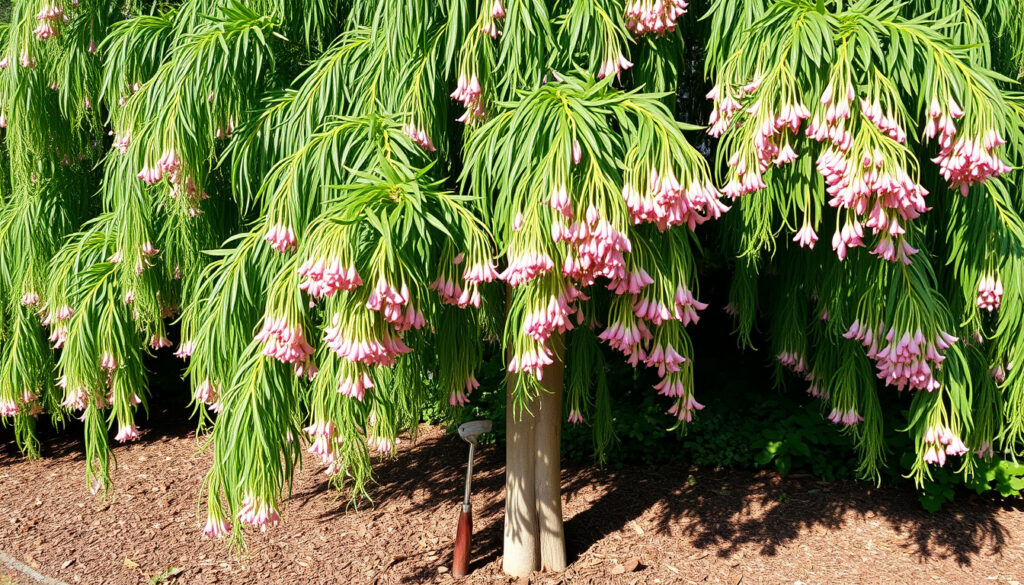
Weeping Lilly Pilly: Size, Growth, Care, Pros & Cons
There’s a moment in every Australian garden where the neighbour’s fence suddenly feels too close and you need something that grows fast, looks graceful, and doesn’t demand constant fussing. The Weeping Lilly Pilly (Waterhousea floribunda) is the tree that often gets picked for that job — but how big does it actually get, and are there hidden costs to its speed? This guide lays out the real dimensions, growth habits, care requirements, and trade-offs so you can decide if it belongs in your patch.
Height: 8–10 m (26–33 ft) ·
Width: 4–5 m (13–16 ft) ·
Growth rate: Fast (1–2 m per year) ·
Lifespan: 20–50 years ·
Foliage: Evergreen, weeping habit ·
Flowers: White fluffy clusters, summer
Quick snapshot
- 8–10 m tall, 4–5 m wide (Oz Briefly)
- Fast growth: 1–2 m per year (Oz Briefly)
- Lifespan 20–50 years (Australian Native Plants Society)
- Can be clipped to hedge height (YouTube gardening guide)
- Not invasive in Australia — native species (Australian Plants Society NSW)
- Roots are non-damaging (ANPSA)
- Safe near buildings and paths (Garden Clinic)
- Evergreen screen or shade tree (Impressive Plants)
- Pink new growth, weeping habit (Oz Briefly)
- Attracts birds, edible berries (ANPSA)
- Coastal and frost tolerant (Australian Plants Society NSW)
- Full sun to part shade (Impressive Plants)
- Well-drained moist soil (Aussie Green Thumb)
- Prune after flowering for shape (Impressive Plants)
- Watch for psyllid pests (Garden Clinic)
Weeping Lilly Pilly grows fast enough to hide a neighbour’s shed in two years — but that speed comes with a size ceiling many gardeners underestimate. Anyone planting within 3 metres of a fence or path faces regular pruning or a tree that outgrows its spot.
Ten facts, one gap: most nursery listings agree on general size but differ wildly on mature height. Here’s what the authoritative sources actually say.
| Label | Value |
|---|---|
| Botanical name | Waterhousea floribunda (syn. Syzygium floribundum) |
| Height | 8–10 m (26–33 ft); up to 30 m in native habitat (ANPSA) |
| Width | 4–5 m (13–16 ft) |
| Growth rate | Fast: 1–2 m per year in optimal conditions (Oz Briefly) |
| Lifespan | 20–50 years (Australian Plants Society NSW) |
| Sunlight | Full sun to partial shade |
| Soil | Well-drained, moist; tolerates clay and sandy soils (Impressive Plants) |
| Hardiness | USDA zones 9–11 (down to -5°C) (Australian Plants Society NSW) |
| Flowering | White fluffy clusters, summer (Oz Briefly) |
| Fruit | Small pinkish berries, edible (ANPSA) |
How big does a Weeping Lilly Pilly grow?
The short answer: 8 to 10 metres tall, 4 to 5 metres wide, if left unpruned. But the real answer depends heavily on where you plant it and which source you trust. According to the Australian Native Plants Society (Australia) (ANPSA), the species in its natural riverine rainforest habitat can reach up to 30 metres — a figure that catches many suburban gardeners off guard. In cultivation, most trees stay between 6 and 15 metres, with nursery listings varying from the modest 6-metre estimate by ANPSA to the 15-metre tall claim from Able Nursery.
How quickly does Weeping Lilly Pilly grow?
- Growth rate: 1–2 metres per year in good conditions (Oz Briefly)
- Able to add 1 metre of height annually under full sun and consistent moisture (Garden Clinic)
- Slower growth in shade or poor soil, but still faster than most evergreen alternatives
What is the lifespan of a Lilly Pilly?
- Typical lifespan: 20 to 50 years (Australian Plants Society NSW)
- Stress factors (severe drought, psyllid infestation, compacted soil) reduce longevity
- Well-cared-for specimens in rainforest remnants may exceed 50 years
The implication: the Weeping Lilly Pilly is not a tree you outgrow. Planting it means committing to a tree that will dominate its spot for decades — and that speed of growth doubles as a maintenance obligation for anyone choosing a hedge form.
Is the Weeping Lilly Pilly invasive?
No — the Weeping Lilly Pilly is not considered invasive anywhere in Australia, and the question usually arises from confusion with exotic hedge plants like privet. According to Australian Plants Society NSW, it is native to riverine rainforests from the North Coast of New South Wales into far northern Queensland. It belongs in Australian gardens as part of the local ecosystem, not as a weed risk.
Are Weeping Lilly Pilly roots invasive?
- Root system is fibrous and non-aggressive (ANPSA)
- Rarely damages building foundations or underground pipes (Garden Clinic)
- May lift pavers if planted within 2 metres of a path — but this is a minor concern compared to other fast-growing trees
The pattern: the root story is actually one of the tree’s most compelling features. Where many fast growers have aggressive root systems, Waterhousea floribunda stays polite. That makes it one of the safer natives for suburban blocks and near-house planting.
The non-invasive roots mean you can plant a Weeping Lilly Pilly within 2–3 metres of your house without worrying about foundation cracks — something you can’t say for many exotic fast-growing trees. For the risk-averse gardener, that’s the single biggest argument in its favour.
The implication: gardeners with limited space can still rely on this tree’s contained root system, provided they manage the above-ground size.
How to grow Weeping Lilly Pilly?
Seven care factors, one overriding rule: consistency. The Weeping Lilly Pilly performs best when moisture and sunlight are kept regular. Here’s the essentials from Impressive Plants and Aussie Green Thumb:
- Sunlight: Full sun to partial shade — at least 4–6 hours direct sun for best growth
- Soil: Well-drained, moist soil enriched with organic matter; tolerates clay and sandy types
- Watering: Regular watering when young; established trees handle short dry spells but not prolonged drought (Aussie Green Thumb)
- Fertiliser: Slow-release native fertiliser in spring and autumn (Impressive Plants)
- Mulching: Mulch to retain moisture, keep away from trunk
- Hardiness: USDA zones 9–11; cold-tolerant to about -5°C (Australian Plants Society NSW)
- Spacing for hedges: 50 cm for dense hedge (YouTube gardening guide); 1–1.5 m for privacy screen (Impressive Plants)
How to prune a Weeping Lilly Pilly?
- Prune after flowering (late summer) to shape or encourage hedge density (Impressive Plants)
- Lightly tip-prune after each flush of new growth for denser foliage
- Can be clipped to 5 metres for a manageable hedge (YouTube gardening guide)
- Remove crossing or dead branches in winter to maintain structure
The catch: pruning isn’t optional if you plant within 5 metres of a structure. The Weeping Lilly Pilly’s growth is relentless — skipping a season of pruning can add 1–2 metres of wild growth.
What is the ideal climate for Weeping Lilly Pilly?
- Warm temperate to subtropical (coastal NSW and Queensland are ideal) (Australian Plants Society NSW)
- Performs in Mediterranean climates with supplemental summer water
- Not suitable for inland deserts or very cold mountain zones (below -7°C)
- Tolerates coastal salt spray, making it a candidate for seaside gardens (Garden Clinic)
What are the negatives of lilly pilly?
Four common complaints surface from Garden Clinic and nursery feedback:
- Fruit drop: The small pinkish berries fall and create a mess under the canopy — a nuisance near patios or driveways
- Psyllid pests: Pimple-like galls on leaves appear when the tree is stressed (poor soil, drought) (Garden Clinic)
- Bird and wasp attraction: Fruiting draws birds and can attract paper wasps, especially in summer
- Size creep: Unpruned trees exceed 10 metres, making them too large for small gardens (Garden Clinic)
What are common Weeping Lilly Pilly problems?
- Psyllid galls: Raised bumps on new foliage; usually cosmetic but can defoliate the tree if left untreated
- Root lift: Pavers near the trunk may shift as the fibrous root mat thickens
- Lanky growth in shade: Less than 4 hours of direct sun causes leggy, sparse foliage
- Drought stress: Leaves curl and drop when summer watering is neglected for weeks
The pattern: most problems trace back to one thing — planting in the wrong spot. A Weeping Lilly Pilly in a cramped courtyard with poor soil will attract psyllids, drop fruit on your furniture, and outgrow its home. Plant it in open soil with regular care, and those issues mostly vanish.
The psyllid pest is the biggest headache for Australian gardeners. Healthy, well-watered trees rarely suffer it, but stressed specimens become a breeding ground. If you see pimple-like bumps on new leaves, improve watering and apply a horticultural oil — ignoring it for a season can lead to partial defoliation.
The implication: most problems are preventable with proper siting and care, not inherent flaws in the tree itself.
What are the benefits of a Weeping Lilly Pilly?
Six advantages, one unifying theme: it does the job of a fast screen without the mess of exotic alternatives. Here’s the case from ANPSA and Impressive Plants:
- Fast evergreen screen: Reaches 4–5 metres in 3–4 years, blocking sightlines effectively
- Aesthetic appeal: Bright pink new growth contrasts with dark green mature leaves; weeping habit adds softness to the landscape
- Wildlife value: Berries attract native birds; dense foliage provides nesting sites
- Low maintenance once established: Requires watering only in extended dry periods after the first 2 years
- Coastal tolerance: Withstands salt-laden winds better than many exotic hedges
- Edible fruit: Small tarty berries for cooking (jams, sauces) — though not the main reason to plant it
What are the pros and cons of a Weeping Lilly Pilly hedge?
Upsides
- Fastest native hedge option — 2–3 years to a solid screen
- Responds well to regular clipping (YouTube guide)
- Evergreen — no bare winter gaps
- Non-invasive roots safe near fences
- Dense foliage if pruned correctly
Downsides
- Needs pruning 1–2 times per year to stay hedge-shaped
- Fruit drop on paths near hedge base
- Can become too tall if hedge height isn’t maintained (Garden Clinic)
- Psyllids more likely in stressed hedges
- Spacing matters: too close = overcrowding, too far = gaps
The implication: for a privacy screen that must be at least 3 metres tall, few natives compete with the Weeping Lilly Pilly on speed. For a low hedge (under 2 metres), a dwarf cultivar like ‘Cascade’ (3–4 m) or ‘Whisper’ (8 m) might be a better fit.
Does Weeping Lilly Pilly produce fruit?
- Yes — small pinkish berries appear after summer flowering (ANPSA)
- Edible but tart — better cooked than fresh
- Attracts fruit-eating birds (silvereyes, rosellas) which then distribute seeds
- Fruit drop under the canopy can stain paving if not cleaned promptly
What this means: if you plant this tree over a patio or driveway, be prepared for a seasonal clean-up. If you have a garden with bare soil or mulch underneath, the fruit is a free bird feeder — a net positive for biodiversity.
The same features that make Weeping Lilly Pilly a great screen — speed, lush foliage, weeping form — create the maintenance burden most gardeners under-estimate. The tree is not a set-and-forget plant. It rewards attention and punishes neglect.
Weeping Lilly Pilly confirmed facts and what’s unclear
Confirmed facts
- Not invasive in Australia — native species (Australian Plants Society NSW)
- Grows 8–10 m tall if left unpruned; up to 6 m in many garden settings (ANPSA)
- Non-aggressive root system, safe near structures (ANPSA)
- Produces edible berries (ANPSA)
What’s unclear
- Precise lifespan under different climates (literature ranges 20–50 years)
- Long-term root behaviour in very confined spaces (pots, narrow garden beds)
- Exact susceptibility to psyllid pests across all cultivars
- Growth rate is fast (1–2 m/year) — but depends heavily on conditions (Oz Briefly)
- Evergreen foliage with weeping habit — standard description, but cultivars vary (Oz Briefly)
“Waterhousea floribunda is an Australian native with a slightly drooping habit, often used as a hedge or screen as it responds well to pruning.”
— The Tutu Guru
“The species is widely planted as an ornamental and prized for its natural weeping form.”
— Wikipedia: Syzygium floribundum
For Australian gardeners choosing between speed and manageability, the Weeping Lilly Pilly is a compelling native with one clear rule: respect its size potential, and it will reward you. Ignore it, and you’ll spend weekends wrestling a 10-metre giant. The choice isn’t between good and bad — it’s between informed placement and costly regret.
greg.app, greg.app, fourseasonsnursery.com.au, impressiveplants.com.au, anpsa.org.au
Frequently asked questions
Where can I buy a Weeping Lilly Pilly?
Most Australian nurseries stock it, including Impressive Plants (online with pot sizes from 20 cm to 100 L bags), Speciality Trees, and Bunnings retail nurseries. Check availability for cultivars ‘Whisper’ and ‘Cascade’.
Does Weeping Lilly Pilly attract birds?
Yes — the small pinkish berries attract native birds like silvereyes, rosellas, and wattlebirds. The dense foliage also provides nesting habitat, making it a strong choice for wildlife-friendly gardens.
Can Weeping Lilly Pilly be grown in pots?
Yes, but with limits. Dwarf cultivars like ‘Cascade’ (3–4 m) perform better in large containers (50 L plus). Standard Waterhousea floribunda will outgrow a pot within 5–8 years due to root constraints affecting vigour and health.
How to treat pests on Weeping Lilly Pilly?
For psyllid pimple gall: improve watering and mulch, apply horticultural oil or neem oil to new growth. Severe infestations may require a systemic insecticide (consult a local nursery). Healthy, well-watered trees rarely need treatment.
Is Weeping Lilly Pilly suitable for small gardens?
Only with regular pruning or by choosing a dwarf cultivar. The standard form reaches 8–10 m — too large for most suburban courtyards. ‘Cascade’ (3–4 m) or ‘Whisper’ (8 m but columnar) are better options for tight spaces.
What is the difference between Weeping Lilly Pilly and regular Lilly Pilly?
The Weeping Lilly Pilly (Waterhousea floribunda) has a distinctive weeping habit and larger leaves than common Lilly Pillies like Syzygium australe. It also grows taller and faster, with a softer, cascading form rather than an upright bushy shape.
How often to water Weeping Lilly Pilly?
Young trees: 2–3 times per week in dry weather for the first 2 years. Established trees (after 2 years): deep water every 1–2 weeks during dry spells. Avoid frequent shallow watering — infrequent deep soaking encourages deeper roots.
For Australian gardeners facing the screen-or-shade decision, the choice is clear: plant the Weeping Lilly Pilly with 4 metres of clearance, commit to annual pruning, and enjoy one of the best-performing native evergreens — or plant a dwarf cultivar and save yourself the weekend labour.
More related posts
 RAC Esperance Holiday Park: Location, Amenities & Tips
 Mickey Mouse: Slang Meaning, Original Name, Age & Friends
 Christopher Walken: His Speech, Natalie Wood, and More
 Marc Jacobs: Biography, Luxury Status, and Personal Life
 Million Dollar Baby – Cast, Oscars, Ending Explained
 John Walker: Marvel, Spy, Runner, and Whiskey – Who Was He
 Jack Johnson: Boxer, Musician, Hockey Player and Historic Pardon
