Martin Luther: The Monk Who Sparked the Protestant Reformation
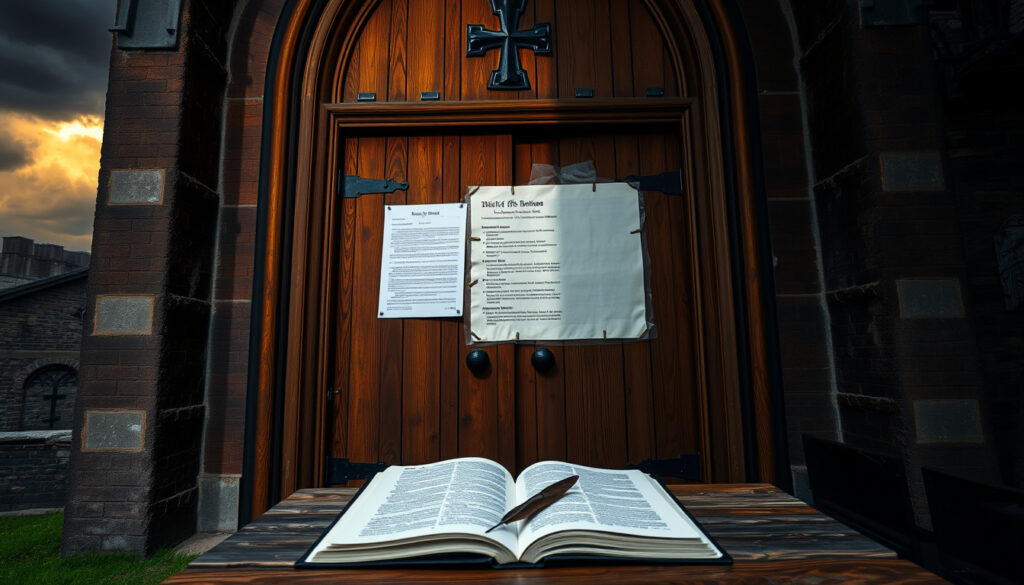
Few figures in Western history still stir as much debate as a German monk who, in 1517, took issue with the sale of indulgences. Martin Luther’s challenge to church authority didn’t just spark a theological argument—it cracked open the religious unity of Europe.
Born: 10 November 1483, Eisleben, Saxony ·
Died: 18 February 1546, Eisleben ·
Key Event: 95 Theses posted in 1517 ·
Known For: Sparking the Protestant Reformation ·
Spouse: Katharina von Bora (m. 1525) ·
Major Work: Translation of the Bible into German
Quick snapshot
- Martin Luther posted the 95 Theses on 31 October 1517 (Book of Concord (Lutheran confessional text))
- He was excommunicated by Pope Leo X in 1521 (Library of Congress (U.S. national library))
- He translated the New Testament into German in 1522 (National Library of Scotland (national heritage institution))
- The exact wording of the 95 Theses as posted is debated; only later printed copies survive (Wikipedia (community encyclopedia))
- Whether Luther actually nailed the theses to the door or mailed them to church authorities is uncertain (Library of Congress (U.S. national library))
- 1483: Born in Eisleben (National Geographic Society (educational non-profit))
- 1517: Posted the 95 Theses (Book of Concord (Lutheran confessional text))
- 1521: Diet of Worms and excommunication (Library of Congress (U.S. national library))
- 1546: Died in Eisleben (Musée protestant (specialized museum in France))
- Luther’s ideas spread via the printing press and led to the formation of Lutheran churches across Europe (National Geographic Society (educational non-profit))
- His German Bible translation standardized the language and made Scripture accessible to laypeople (National Library of Scotland (national heritage institution))
Eight key facts, one pattern: Luther’s life was a series of decisive breaks—from monastic routine to papal authority.
| Label | Value |
|---|---|
| Full Name | Martin Luther |
| Born | 10 November 1483, Eisleben, Saxony |
| Died | 18 February 1546, Eisleben |
| Known For | Posting the 95 Theses, starting the Reformation |
| Spouse | Katharina von Bora (m. 1525) |
| Children | 6 (3 survived infancy) |
| Education | University of Erfurt (Master of Arts), University of Wittenberg (Doctor of Theology) |
| Denomination | Originally Roman Catholic, later Lutheran |
Luther, an Augustinian monk who had taken vows of obedience, ended up defying the highest ecclesiastical authority in Europe. His commitment to conscience over hierarchy created a movement he never intended to start.
What was Martin Luther most famous for?
What did Martin Luther do in Christianity?
- Martin Luther is most famous for initiating the Protestant Reformation in 1517 (Library of Congress (U.S. national library)).
- He posted the 95 Theses on the door of the Wittenberg Castle Church, challenging the sale of indulgences (Book of Concord (Lutheran confessional text)).
What was Martin Luther’s biggest achievement?
His translation of the Bible into German, completed in 1534, gave ordinary people direct access to Scripture and shaped the German language (National Library of Scotland (national heritage institution)). The Free Speech Center at MTSU (academic free-expression institute) notes that Luther advocated printing Bibles in the language of the reader rather than in Latin.
How did Martin Luther change the world?
By rejecting papal authority and insisting that Christians are saved through faith alone, Luther broke the religious monopoly of the Catholic Church and paved the way for diverse Protestant denominations (Free Speech Center at MTSU (academic free-expression institute)).
Is Martin Luther a Protestant or Catholic?
Why do Catholics disagree with Martin Luther?
- Luther was a Catholic monk who became a Protestant reformer (Musée protestant (specialized museum in France)).
- He rejected papal authority, the sacramental system (except baptism and the Eucharist), and the doctrine of salvation by works (Free Speech Center at MTSU (academic free-expression institute)).
- His followers became known as Lutherans, a Protestant denomination (National Geographic Society (educational non-profit)).
What was Martin Luther’s main belief?
Luther held that individuals are saved only by personal faith in Jesus Christ and the grace of God, not by performing good works or purchasing indulgences (Free Speech Center at MTSU (academic free-expression institute)). This doctrine—justification by faith alone—was the theological cornerstone of the Reformation.
The pattern: Catholics see Luther’s break as a schism rooted in pride; Protestants see it as a recovery of gospel truth. Both agree his challenge was historic.
What were Luther’s three main ideas?
What was Martin Luther’s main belief?
- Sola scriptura — the Bible is the only source of religious authority (National Library of Scotland (national heritage institution)).
- Sola fide — salvation is through faith alone, not works (Musée protestant (specialized museum in France)).
- Sola gratia — salvation is through God’s grace alone, not human merit (Free Speech Center at MTSU (academic free-expression institute)).
What is justification by faith alone?
Justification by faith alone means that a sinner is declared righteous before God solely through trust in Christ, not through any accumulation of good deeds. Luther called this “the article by which the church stands or falls.”
Why did Martin Luther change the Bible?
What were the 95 Theses?
The 95 Theses were a list of arguments against the sale of indulgences, written in Latin and intended for academic debate (Book of Concord (Lutheran confessional text)). They were not a translation of the Bible, but they launched the Reformation.
What was the Protestant Reformation?
The Protestant Reformation was a 16th-century movement that split Western Christianity, beginning with Luther’s challenge to church practices (National Geographic Society (educational non-profit)). Reformers like Luther, Calvin, and Zwingli created new Protestant denominations, leading to religious wars and the rise of nation-states (Free Speech Center at MTSU (academic free-expression institute)).
What was the Protestant Reformation?
When was Martin Luther born?
10 November 1483, in Eisleben, Saxony (Library of Congress (U.S. national library)).
When did Martin Luther die?
18 February 1546, also in Eisleben (Musée protestant (specialized museum in France)).
What was Martin Luther’s education?
He earned a Master of Arts from the University of Erfurt and a Doctor of Theology from the University of Wittenberg (Musée protestant (specialized museum in France)).
Luther’s insistence on sola scriptura gave ordinary believers direct access to God, but it also removed the institutional check that had mediated interpretation for centuries. The result: a splintered Christianity with no single authority to resolve disputes.
Timeline of Luther’s life and the Reformation
- 1483 — Born in Eisleben, Saxony (Library of Congress (U.S. national library))
- 1505 — Entered the Augustinian monastery (Musée protestant (specialized museum in France))
- 1512 — Received doctorate in theology (Musée protestant (specialized museum in France))
- 1517 — Posted the 95 Theses (Book of Concord (Lutheran confessional text))
- 1521 — Excommunicated; Diet of Worms (Library of Congress (U.S. national library))
- 1525 — Married Katharina von Bora (Musée protestant (specialized museum in France))
- 1534 — Published complete German Bible translation (National Library of Scotland (national heritage institution))
- 1546 — Died in Eisleben (Library of Congress (U.S. national library))
Clarity: What we know and what remains uncertain
Confirmed facts
- Luther posted the 95 Theses in 1517 (Book of Concord (Lutheran confessional text))
- He was excommunicated by Pope Leo X in 1521 (Library of Congress (U.S. national library))
- He translated the New Testament into German in 1522 (National Library of Scotland (national heritage institution))
- He married Katharina von Bora in 1525 (Musée protestant (specialized museum in France))
What’s unclear
- The exact wording of the 95 Theses as initially posted is debated (Wikipedia (community encyclopedia))
- Whether Luther actually nailed the theses to the door or mailed them is uncertain (Library of Congress (U.S. national library))
Quotes on Luther and the Reformation
“Unless I am convinced by the testimony of the Scriptures or by clear reason… I am bound by the Scriptures I have quoted and my conscience is captive to the Word of God. I cannot and will not retract anything, since it is neither safe nor right to go against conscience.”
— Martin Luther, at the Diet of Worms, 1521 (as recorded in contemporary accounts, Library of Congress (U.S. national library))
“A Christian is a perfectly free lord of all, subject to none. A Christian is a perfectly dutiful servant of all, subject to all.”
— Martin Luther, The Freedom of a Christian, 1520 (National Library of Scotland (national heritage institution))
“The Reformation was not a single event but a process of many years, and Luther was its most dramatic figure.”
— Diarmaid MacCulloch, historian (National Geographic Society (educational non-profit))
“Arise, O Lord, and judge your cause. A wild boar has invaded your vineyard.”
— Pope Leo X, in the papal bull Exsurge Domine (1520), condemning Luther’s teachings (Library of Congress (U.S. national library))
What these quotes reveal: Luther saw himself as bound by conscience and Scripture; the papacy saw him as a threat to divine order. Both sides framed their conflict in absolute terms, leaving no room for compromise.
Related reading: Martin Luther and the Lutheran Reformation · Protestant Reformation
luther.de, trinitylutheranchurch.360unite.com, youtube.com, exhibits.lib.arizona.edu, en.wikipedia.org
For a detailed account of how this single document reshaped Christianity, read more about Martin Luthers 95 Theses and the Reformation.
Frequently asked questions
What language did Martin Luther write in?
Luther wrote primarily in Latin for academic works and in German for popular pamphlets and his Bible translation. His German version helped standardize the language (National Library of Scotland (national heritage institution)).
Did Martin Luther have children?
Yes, he and Katharina von Bora had six children, of whom three survived to adulthood (Musée protestant (specialized museum in France)).
Was Martin Luther excommunicated?
Yes, Pope Leo X excommunicated Luther in 1521 after he refused to recant his teachings (Library of Congress (U.S. national library)).
What is the Augsburg Confession?
The Augsburg Confession (1530) is the primary statement of faith for Lutheranism, written by Philipp Melanchthon and based on Luther’s teachings (Free Speech Center at MTSU (academic free-expression institute)).
How did Martin Luther die?
He died of natural causes on 18 February 1546 in Eisleben, while on a journey to resolve a dispute among local nobles (Library of Congress (U.S. national library)).
What is Lutheranism?
Lutheranism is a Protestant denomination that follows Luther’s theological principles: justification by faith alone, the authority of Scripture, and the priesthood of all believers (National Geographic Society (educational non-profit)).
Did Martin Luther translate the entire Bible?
Yes, he translated the entire Bible from the original Hebrew and Greek into German. The New Testament appeared in 1522, and the complete Old Testament was published in 1534 (National Library of Scotland (national heritage institution)).
What was Luther’s view on the Pope?
Luther came to view the Pope as the Antichrist for usurping Christ’s authority and opposing the gospel of grace. He rejected papal supremacy and called for a church governed by Scripture alone (Free Speech Center at MTSU (academic free-expression institute)).
Related reading
- Protestant Reformation — Free Speech Center, Middle Tennessee State University
- Martin Luther and the Lutheran Reformation — Musée protestant
Editor’s note: For modern Christians, the choice Luther posed remains vivid: engage with Scripture directly, as he urged, or rely on institutional mediation. Either way, his challenge reshaped the landscape of faith. The Reformation’s legacy is not just a theological split—it’s a continuing question about authority, conscience, and who gets to interpret God’s word.
More related posts
 Reuben Kaye: Biography, Parents, 2025 Tour Dates
 William Zabka: Cobra Kai Deaths, Black Belt & Net Worth
 Best Coffee Near Me: Top Shops, Brands & Trends in Ireland
 Alex Fevola’s Biography: Family, Career & Reconciliation
 Jason Momoa: Ethnicity, Relationships, Net Worth, Height & Career
 Byeon Woo-Seok: Biography, Marriage Status, Career & Facts
 Nick Mohammed: Biography, Wife, Career, and FAQs (2025)
