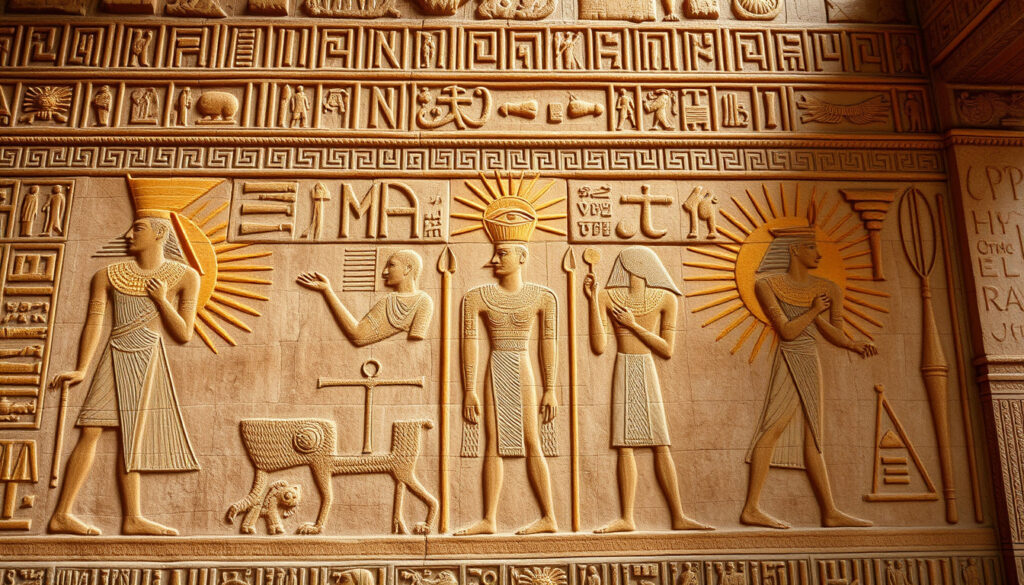
Major Egyptian Gods: Names, Roles & the Ennead
Few pantheons still capture the imagination the way the Egyptian gods do. For thousands of years, these deities shaped daily life, death, and the very order of the universe — and their names still echo through pop culture today.
Major gods in the Ennead: 9 ·
Oldest known god: Ra ·
God of the underworld: Osiris ·
Goddess of magic: Isis ·
God of chaos: Seth ·
God of embalming: Anubis
Quick snapshot
- Originates in Heliopolis, attested in Pyramid Texts (Glencairn Museum)
- Includes nine deities from Atum to Nephthys (British Museum)
- Central to the Heliopolitan creation myth (Glencairn Museum)
- Regional and temporal variations, no fixed canon (Britannica)
- Often includes Ra, Amun, Isis, Osiris, Horus, Anubis, Seth, Ptah, Hathor, Thoth, Bastet, Sobek (Britannica)
- Reflects state cults and political power shifts (Britannica)
- Ra, Osiris, Isis, Horus, Anubis (British Museum)
- Appear in nearly every modern retelling of Egyptian myth (British Museum)
- Core to key myths: creation, death, resurrection (Glencairn Museum)
- Ra: Sun god, creator, king of the gods (Britannica)
- Anubis: Jackal-headed god of embalming and the afterlife (British Museum)
- Mythology ranks Ra as the more powerful deity (Britannica)
Six key facts anchor a sprawling pantheon in specific roles and timelines.
| Attribute | Detail |
|---|---|
| Oldest known Egyptian god | Ra (since 3rd millennium BCE) (Wikipedia) |
| Number of gods in the Ennead | 9 (British Museum) |
| Primary sun god | Ra (later merged with Amun as Amun-Ra) (Wikipedia) |
| God of the dead | Osiris (World History Encyclopedia) |
| Goddess of magic | Isis (Ancient Egypt Online) |
| God of mummification | Anubis (British Museum) |
Who are the 9 major Egyptian gods?
The Heliopolitan Ennead
- The Ennead was the formal state theology of Heliopolis (Glencairn Museum).
- First attested in the Old Kingdom Pyramid Texts (World History Encyclopedia).
- The nine gods are Atum, Shu, Tefnut, Geb, Nut, Osiris, Isis, Set, and Nephthys (British Museum).
Atum, who is frequently equated with Ra as Atum-Ra (World History Encyclopedia), creates the first divine pair. Shu, god of air, and Tefnut, goddess of moisture, give birth to Geb, god of the earth, and Nut, goddess of the sky. These four then produce the final generation: Osiris, Isis, Seth, and Nephthys — the gods who dominate the most famous Egyptian myths.
While the Ennead gives a tidy nine-god model, the actual beliefs on the ground were far more fluid. Most Egyptians prayed to local gods rather than the full Heliopolitan canon.
What this means: The Ennead is more than a list. It is a complete theological system explaining creation, kingship, and the afterlife in a single family structure.
What are the 12 main gods of Egypt?
Common 12-deity lists
- No single authoritative list exists for the “12 main gods” — the number varies by region and era (Britannica).
- A widely cited set includes Ra, Amun, Isis, Osiris, Horus, Anubis, Seth, Ptah, Hathor, Thoth, Bastet, and Sobek.
- The concept of 12 may relate to the hours of the day or the months of the year.
Regional variations
As political capitals shifted, so did the top god. The 12-god lists are best understood as a snapshot of the state religion under specific dynasties.
Memphis favored Ptah as creator god (Wikipedia), while Thebes elevated Amun to the pinnacle of the pantheon, merging him with Ra to create Amun-Ra.
The trade-off: The flexibility of the pantheon allowed regional loyalty, but it makes any fixed “top 12” list a modern invention rather than an ancient reality.
Who were the 10 gods of Egypt?
The Ogdoad and Ennead combined
- Hermopolis featured an Ogdoad (8 gods) representing primordial chaos.
- Adding Ra and Amun to the Ogdoad creates a set of 10 (World History Encyclopedia).
- Some lists merge the nine of the Ennead with a tenth, often Horus or Anubis.
Other ten-god groupings
A set of 10 gods often represents the bridge between the elite, priestly theology of the Ennead and the more inclusive, state-sponsored worship of a broader pantheon.
A common grouping of 10 is Ra, Amun, Isis, Osiris, Horus, Anubis, Seth, Ptah, Hathor, and Thoth.
Why this matters: This grouping highlights how Egyptian theology reconciled different creation narratives by layering gods from distinct cult centers into a single hierarchy.
What are the five Egyptian gods?
The most frequently cited five
- These five are Ra, Osiris, Isis, Horus, and Anubis.
- Each is central to key myths: creation (Ra), death and resurrection (Osiris/Isis), kingship (Horus), and the afterlife (Anubis).
- These five appear consistently in popular culture and museum exhibits.
Why these five are prominent
Their prominence is tied to the Osiris myth cycle, which is the most extensive and culturally significant narrative in Egyptian mythology (Glencairn Museum).
The pattern: These five gods form a self-contained narrative arc from creation to judgment, making them the most resonant for both ancient worshippers and modern audiences.
Who is stronger, Anubis or Ra?
Ra’s attributes and domains
- Ra is the sun god, creator of the world according to Heliopolitan theology (Britannica).
- He was the king of the gods and the father of the pharaoh.
- His cult was centered in Heliopolis, but his worship was universal across Egypt.
Anubis’s attributes and domains
- Anubis is the jackal-headed god of mummification and the dead (British Museum).
- He presides over the embalming ritual and guides souls to the afterlife.
- In the Early Dynastic Period, Anubis was the principal funerary deity before Osiris took on that role (Mark Beare Peterson).
A direct comparison of their domains reveals a clear theological hierarchy.
| Domain | Ra | Anubis |
|---|---|---|
| Primary Role | Sun god, creator, king of the gods | God of embalming, protector of tombs |
| Parentage | Self-created (Atum-Ra) | Son of Ra (early), later Osiris and Nephthys |
| Iconography | Falcon head or ram, solar disk | Jackal head, canine body |
| Role in Myth | Creates the world, battles Apophis daily | Judges the dead, embalms Osiris |
| Worship Centers | Heliopolis, Thebes (as Amun-Ra) | Cynopolis, strong local cults |
| Power Rank | Supreme in the pantheon | Powerful but subordinate to Ra and Osiris |
While Anubis wields undeniable authority over the fate of every soul, Ra’s cosmic role as creator and daily renewer of the world places him on a distinctly higher tier in the Egyptian hierarchy.
The comparison confirms that while Anubis holds crucial authority over the afterlife, Ra’s cosmic dominion places him at the top of the pantheon.
What’s clear and what’s not
Confirmed facts
- The Heliopolitan Ennead consists of nine specific gods: Atum, Shu, Tefnut, Geb, Nut, Osiris, Isis, Set, and Nephthys. (British Museum)
- Ra was the most prominent sun god in ancient Egypt (Britannica).
- Osiris ruled the underworld and was the judge of the dead (Mark Beare Peterson).
- Anubis oversaw the embalming process and was depicted as a jackal (Ancient Egypt Online).
What’s unclear
- Which exact gods belong to a “12 main gods” list; no universal canon exists. (Britannica)
- Whether the Ennead originally included Horus; some lists do, some don’t. (World History Encyclopedia)
- The exact number of gods worshiped across all periods; estimates range from dozens to over 1,500. (World History Encyclopedia)
- Whether the Ennead was universally acknowledged outside of Heliopolis. (Glencairn Museum)
- The degree to which the Ennead’s composition varied over time. (Britannica)
Expert perspectives
The Great Ennead of Heliopolis provides the earliest known structured list of Egyptian deities, beginning with the creator god Atum.
British Museum educational resources
No single list of twelve gods was ever universally accepted in ancient Egypt. The composition shifted as different cities promoted their own patron deities.
Britannica entry on Egyptian gods
The evolution of the pantheon across dynasties shows a deliberate effort to reconcile local traditions into a national framework, a process that never fully settled into a single canon.
Egyptologist Dr. Garry Shaw
For modern readers trying to map the major Egyptian gods, the conflicting lists are not a bug — they are a feature of a religion that evolved over three millennia. The Ennead offers the clearest theological foundation. The 12-god lists reflect the shifting political realities. The five most famous gods carry the narrative power that made Egyptian mythology endure. The ancient Egyptians adapted their beliefs to an ever-changing world, and the lists reveal this process.
markberepeterson.com, en.wikipedia.org, britishmuseum.org, marvel.com, museum.wa.gov.au, britishmuseumshoponline.org, study.com, artsandculture.google.com
Readers seeking a clear explanation of the Ennead will appreciate a clear explanation of the Ennead.
Frequently asked questions
What is the difference between Ra and Amun-Ra?
Ra was the sun god of Heliopolis. Amun was the hidden creator god of Thebes. When Thebes rose to power, the two were fused into Amun-Ra, the supreme state god.
Was Anubis the son of Osiris?
According to later Egyptian mythology, Anubis is the son of Osiris and Nephthys (Ancient Egypt Online). In the earliest traditions, he was considered a son of Ra.
Why did Egyptians worship so many gods?
Egypt was a collection of regional nomes, each with its own patron deity. As the state unified, local gods were grouped, merged, and ranked into a national pantheon.
Which Egyptian god had a jackal head?
Anubis, the god of embalming and protector of the dead, is depicted with the head of a jackal. This symbolized his connection to cemeteries, where jackals were commonly seen.
What is the role of Horus in Egyptian mythology?
Horus, the falcon-headed god, was the son of Osiris and Isis. He avenged his father’s death and became the ruler of the living, embodied by the living pharaoh.
Who was the god of the Nile?
The god Hapi was the deity of the annual flooding of the Nile. Sobek, the crocodile god, also was associated with the river’s fertility and danger.
Are there female Egyptian gods besides Isis?
Yes. Major goddesses include Nut (sky), Tefnut (moisture), Hathor (love), Bastet (protection), Sekhmet (war), Nephthys (protection of the dead), and Maat (truth and order).
What happened to Seth after he killed Osiris?
Seth murdered his brother Osiris and claimed the throne. Horus eventually defeated Seth in a series of contests, and Seth was exiled or integrated as a god of chaos and storms.
More related posts
 Ken Done: Biography, Art Value, Controversy, and FAQs (2024)
 Alcohol Delivery Near Me: Fast Options & Health Rules
 Gilson South Yarra – Menu, Hours and Dining Guide
 Doctors Certificate Online Ireland: Get Sick Note Fast
 The Best Hiking Boots for Ireland: 2026 Buyer’s Guide
 Andrew Place Clinic: Bundoora & Mill Park GPs, Fees
 RFK Jr.’s Brain Worm and Health: Key Facts Explained
 Kmart Mt Barker – Location Hours Contact and Directions
