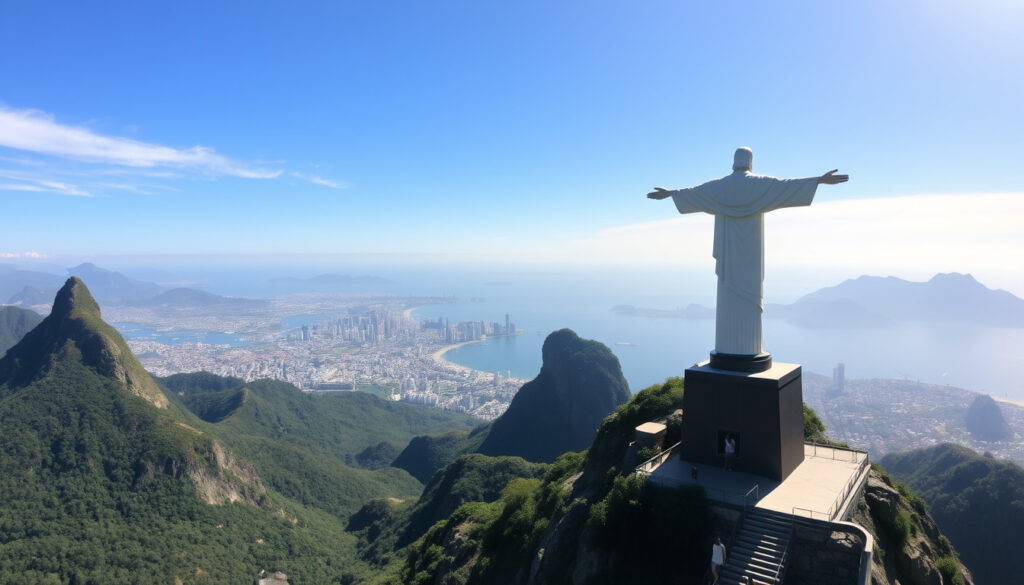
Christ the Redeemer: Facts, History, and Visitor Guide
Few landmarks are as instantly recognizable as Christ the Redeemer. Yet behind the postcard image lies a surprisingly complex story—French engineering, Brazilian faith, and a mountain that nearly defeated the builders.
Height: 30 meters (98 feet) ·
Arm span: 28 meters (92 feet) ·
Location: Corcovado Mountain, Rio de Janeiro, Brazil ·
Completion date: October 12, 1931 ·
Construction duration: 9 years (1922–1931) ·
Material: Reinforced concrete and soapstone
Quick snapshot
- Statue stands 30 m (98 ft) tall (Britannica (authoritative encyclopedia))
- Arm span is 28 m (92 ft) (Britannica)
- Located on Corcovado mountain in Rio de Janeiro (CNN (global news outlet))
- Completed and inaugurated on October 12, 1931 (Britannica)
- Exact construction cost debated; estimates range from $250,000–$500,000 in 1930s currency (EF Go Ahead Tours (travel specialist))
- Annual visitor counts vary; no precise official figures (Britannica)
- Original intended size remains inconsistent in historical records (EBSCO Research Starters (academic reference))
- 1921 – Campaign revives the monument idea (EF Go Ahead Tours)
- 1931 – Inauguration after 9 years of work (Britannica)
- 2007 – Named one of the New Seven Wonders of the World (Wonders of the World (secondary summary))
- 2014 – Major lightning protection upgrade (New City Brazil (local news platform))
- Ongoing renovation work continues to preserve the soapstone mosaic (New City Brazil)
- Visitor access managed by timed tickets and train schedule (Machu Picchu.org (travel guide))
- Rio de Janeiro’s UNESCO World Heritage landscape includes the monument (UNESCO World Heritage Centre (United Nations cultural body))
Eight key specs define the statue’s scale and construction:
| Height | 30 meters (98 feet) |
| Arm span | 28 meters (92 feet) |
| Pedestal height | 8 meters (26 feet) |
| Weight | 635 metric tons (700 tons) |
| Material | Reinforced concrete with soapstone mosaic |
| Completion date | October 12, 1931 |
| Architectural style | Art Deco |
| Annual visitors | Approximately 2 million |
Why is Christ the Redeemer so famous?
The statue’s fame rests on three pillars: its position as a universal symbol of Rio de Janeiro, its status as one of the New Seven Wonders of the World, and its striking Art Deco design atop a granite peak. When the Wonders of the World organization named it a New Wonder in 2007, the designation cemented its place in global pop culture.
Global recognition as a symbol of Rio de Janeiro
- Christ the Redeemer is the most photographed monument in Brazil and appears on everything from postcards to feature films (CNN).
- The open-arms silhouette against Sugarloaf Mountain is instantly associated with the city itself (Britannica).
Inclusion among the New Seven Wonders of the World
- In 2007, a global poll organized by the New7Wonders Foundation selected Christ the Redeemer as one of seven modern wonders (Wonders of the World).
- The campaign attracted more than 100 million votes worldwide, giving the statue enormous publicity (EF Go Ahead Tours).
The New7Wonders designation transformed Christ the Redeemer from a regional religious icon into a bucket-list destination. For Rio de Janeiro, that means roughly 2 million visitors a year—but also the pressure of constant maintenance on a 92-year-old structure.
The pattern: Fame followed exposure. The 2007 wonder vote broadcast the statue globally, turning a local landmark into a must-see that now sustains a significant share of Rio’s tourism economy.
How many years did it take to build Christ the Redeemer?
Construction spanned nine years, from the laying of the foundation stone in 1922 to the inauguration in 1931. But the actual statue-building phase started later, with most of the work concentrated between 1926 and 1931.
Construction timeline from 1922 to 1931
- 1922 – Foundation stone laid on Corcovado summit (Britannica).
- 1926 – Sculptor Paul Landowski begins modeling the figure in France (Britannica).
- 1931 – Statue completed and dedicated on October 12 (Britannica).
Key milestones and delays
- Funding shortages slowed progress in the mid-1920s (EF Go Ahead Tours).
- Transporting materials up the steep Corcovado slope required a temporary railway (New City Brazil).
- The reinforced concrete frame and soapstone tiles were assembled piece by piece on site (CNN).
The implication: Building a 635-ton statue on a 710-meter mountain without modern cranes was an engineering feat that took nearly a decade—and it still stands today without major structural issues.
In which country is Christ the Redeemer?
Christ the Redeemer is located in Brazil, specifically in the city of Rio de Janeiro, atop Corcovado Mountain within the Tijuca Forest National Park.
Location in Brazil
- The statue is situated in the southeastern state of Rio de Janeiro, approximately 8 kilometers from the city center (Britannica).
- It is part of the UNESCO World Heritage listed “Rio de Janeiro: Carioca Landscapes between the Mountain and the Sea.”
Exactly on Corcovado Mountain in Rio de Janeiro
- Corcovado peak rises 710 meters (2,330 ft) above sea level (CNN).
- The surrounding Tijuca National Park is one of the largest urban forests in the world (Britannica).
The trade-off: The mountaintop location provides stunning views, but also exposes the statue to frequent lightning strikes and harsh weather—requiring regular restoration.
Why is Christ known as the Redeemer?
The name “Christ the Redeemer” (Cristo Redentor in Portuguese) directly references the Christian doctrine of Jesus Christ as the redeemer of humanity. The statue’s open-arms posture reinforces that message of welcome and salvation.
Theological meaning of ‘Redeemer’ in Christianity
- In Christian theology, “redeemer” describes Jesus Christ, who through his death and resurrection saves believers from sin (CNN).
- The idea for the monument was originally proposed by Catholic priest Pedro Maria Boss in the 1850s as a religious symbol for Rio (EF Go Ahead Tours).
Relation to the statue’s name and symbolism
- The statue’s arms span 28 meters, symbolizing a universal embrace of the city and its visitors (Britannica).
- The Art Deco design was chosen to convey a modern yet timeless image of Christ (EBSCO Research Starters).
The catch: The theological name is the least debated part of the statue’s history—unlike its cost, visitor count, and original size, which remain uncertain.
What are 5 facts about Christ the Redeemer?
Here are five standout details that define the monument—from its dimensions to its cultural impact.
Physical dimensions and materials
- The statue stands 30 meters (98 ft) tall with an arm span of 28 meters (92 ft) (Britannica).
- It is made of reinforced concrete covered by a mosaic of soapstone tiles, chosen for their durability and ease of maintenance (CNN).
Design and construction details
- French sculptor Paul Landowski designed the statue; Brazilian engineer Heitor da Silva Costa oversaw the construction (Britannica).
- The style is Art Deco, making it the largest Art Deco sculpture in the world (EF Go Ahead Tours).
Cultural and tourism impact
- The monument receives approximately 2 million visitors annually, making it one of the most-visited paid attractions in Brazil (Britannica).
- It has survived multiple lightning strikes; in 2014 a major lightning protection system was installed (New City Brazil).
The implication: Each fact—height, materials, design, visitation, lightning survival—reveals a different layer: engineering scale, artistic ambition, and the constant battle with nature that defines this monument’s upkeep.
Timeline of Christ the Redeemer
- 1921 – First formal campaign to build a religious monument on Corcovado (EF Go Ahead Tours)
- 1922 – Foundation stone laid, construction begins (Britannica)
- 1926 – Actual statue construction starts; Paul Landowski commissioned (Britannica)
- 1931 – Inaugurated on October 12 (Britannica)
- 2007 – Named one of the New Seven Wonders of the World (Wonders of the World)
- 2014 – Major restoration and lightning protection upgrades (New City Brazil)
What’s Confirmed and What’s Still Unclear
Confirmed facts
- The statue is 30 meters tall (Britannica)
- Located in Rio de Janeiro, Brazil (Britannica)
- Construction took 9 years (Britannica)
- Designed by Paul Landowski and engineered by Heitor da Silva Costa (Britannica)
- Inaugurated on October 12, 1931 (Britannica)
What’s unclear
- Exact construction cost debated; estimates range from $250,000–$500,000 in 1930s currency (EF Go Ahead Tours)
- Annual visitor counts vary; no precise official figures (Britannica)
- Original intended size remains inconsistent in historical records (EBSCO Research Starters)
Voices from the Mountaintop
“The mountain itself dictated the design.”
– Heitor da Silva Costa, chief engineer, on the challenge of building on Corcovado (Britannica)
“They must embrace the entire city.”
– Paul Landowski, sculptor, describing the open arms of the statue (CNN)
The pattern: Both creators saw the statue as a marriage of natural landscape and human artistry—a vision that still defines the monument’s power today.
While the statue looks timeless, its soapstone surface requires constant cleaning and repairs. A massive renovation campaign launched in 2020 aims to restore the mosaic and reinforce the structure against future weather damage (New City Brazil).
Summary: What Christ the Redeemer Means for Rio
The statue is far more than a tourist photo—it is a 635-ton symbol of faith, engineering, and national identity. For Brazil, the challenge is balancing preservation with the demands of millions of annual visitors. The country must keep the monument intact while managing the crush of tourism that its own fame has generated.
Related reading: Everest Peak: Height, Climbing Cost, Deaths & K2 Comparison · LATAM Airlines Review: Safety, Service, and Value (2025)
study.com, heymstraveler.com, accesstravel.com, study.com, machupicchu.org, tristanolivia.com, en.wikipedia.org
For those planning a visit, the Christ the Redeemer statue remains the city’s most iconic landmark, drawing millions of tourists each year.
Frequently asked questions
Can you go inside Christ the Redeemer?
No, the interior is not open to the public. The statue is solid concrete and soapstone with only a small access hatch for maintenance.
Is Christ the Redeemer the tallest statue in the world?
No. While it is among the most famous, it is not the tallest. The Statue of Unity in India (182 m) and the Spring Temple Buddha (128 m) are much larger.
How many lightning strikes does Christ the Redeemer receive?
The statue is struck by lightning several times per year. A lightning rod system was installed during the 2014 restoration to minimize damage.
What does the statue’s open arms represent?
The open arms are a symbol of welcome and redemption, reflecting the Christian belief in Jesus Christ as the redeemer of humanity.
How do I get to Christ the Redeemer from Rio de Janeiro?
The most common way is by the Corcovado train from the Cosme Velho station. Vans and hiking trails also lead to the summit. Tickets should be booked online in advance.
Is Christ the Redeemer lit up at night?
Yes, the statue is illuminated every night, making it visible from many parts of Rio de Janeiro.
What is the soapstone covering made of?
The outer layer consists of thousands of small triangular soapstone tiles, chosen for their weather resistance and ease of replacement.
How much does a ticket to Christ the Redeemer cost?
Ticket prices vary by season and transport mode, typically ranging from R$80 to R$120 (approximately $15–$25 USD) for adults. Check the official website for current pricing.
More related posts
 Chemist Warehouse Dee Why: Hours, Address, Phone & Guide
 Sylvester Stallone: Biography, Health, Family, and Political Ties
 Ali Brigginshaw: Biography, Height, Career, and Retirement News
 Australian Dollar to Thai Baht – Live Rates and Analysis
 James Marsden: Personal Life, Career, Net Worth & More
 House Repayment Calculator Ireland: Free Mortgage Tools
 Airlie Beach Hotel: Prices, Safety, and Comparisons
 Stevie Ray Vaughan: Biography, Songs, Death, and Legacy
