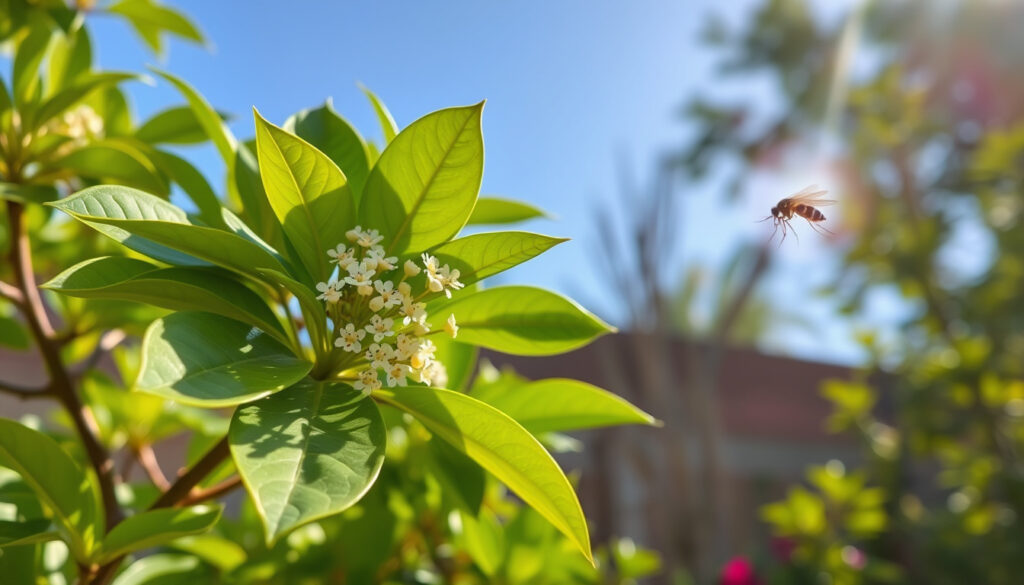
Lemon Myrtle Tree: Growing, Care, and Mosquito Repellent Guide
If you’ve ever crushed a lemon myrtle leaf between your fingers, you know the scent is unmistakable — sharp, sweet, and cleaner than any bottled lemon oil. This Australian native tree brings that fragrance into home gardens, while also offering edible leaves and natural insect-repellent properties. Whether you’re curious about its size, wondering where to plant it, or hoping to use it against mosquitoes, this guide lays out the evidence-based facts.
Max height: 8 m (26 ft) ·
Native to: Australia ·
Foliage scent: Strong lemon ·
Uses: Tea, insect repellent, essential oil ·
Growth habit: Tree or shrub (cooler climates)
Quick snapshot
- Botanical name Backhousia citriodora (Australian National Botanic Gardens)
- Leaves are strongly lemon-scented (Australian Geographic)
- Prefers full sun and well-drained soil (DPIRD Western Australia)
- Root invasive potential — no official warnings found; anecdotal evidence suggests non-invasive (citronellal)
- Mosquito repellent efficacy — some laboratory studies support citronellal, but human trials are limited
- From seed to first harvest: 2–3 years in ideal conditions
- Mature height (8 m) reached in 10–15 years
- More human-exposure studies on mosquito repellency needed to confirm field effectiveness (DPIRD Western Australia)
- Growing interest in lemon myrtle as a commercial bush food crop in Australia (DPIRD Western Australia)
Ten key facts, one pattern: lemon myrtle is a versatile native that needs warmth and good drainage to thrive in a home garden.
| Attribute | Detail |
|---|---|
| Botanical Name | Backhousia citriodora |
| Common Names | Lemon myrtle, lemon scented myrtle, lemon scented ironwood |
| Family | Myrtaceae |
| Height | Up to 8 m (26 ft) |
| Spread | 3–4 m (10–13 ft) |
| Sunlight | Full sun |
| Soil | Well-drained, rich in organic matter |
| Native Range | Queensland, Australia |
| Flower | Small white fluffy clusters in summer |
| Harvest | Leaves can be picked year-round |
How big does a lemon myrtle tree grow?
Typical height and spread
In ideal conditions — fertile soil, ample moisture, and a warm subtropical climate — a lemon myrtle can reach up to 8 m (26 ft) tall with a spread of 3–4 m, according to the Australian National Botanic Gardens (ANBG). That’s roughly the height of a two-storey house.
Growth rate
- From a seed or cutting, expect 30–60 cm of growth per year during the first three years in suitable conditions.
- Some wild specimens have been reported at 20 m, but those are outliers in rainforest margins, not garden trees (Jane Grows Garden Rooms (gardening blog)).
Shape and canopy
The tree forms a dense, rounded canopy of elliptical leaves that release a strong lemon aroma when crushed (Australian Geographic). Regular pruning can keep it as a compact shrub or hedge, especially in cooler areas where growth is slower.
Home gardeners who want a full-sized tree need patience: 10–15 years to reach 8 m. For faster screening, consider planting a group of three closer together.
This makes lemon myrtle a slower-growing choice compared to many fast-growing Australian natives, but the wait rewards with a robust, aromatic tree.
Where is the best place to plant a lemon myrtle tree?
Sunlight requirements
Lemon myrtle performs best in full sun (at least six hours of direct light daily). A position that is protected from strong winds during the first year helps young plants establish, as noted by DPIRD Western Australia.
Soil preferences
- Well-drained soil enriched with compost or organic matter is ideal.
- Waterlogged soils are a key risk — the roots rot easily in heavy clay (DPIRD Western Australia).
Climate considerations
This species is native to the subtropical east coast of Australia. It grows best in subtropical to warm temperate zones. Young plants are frost-sensitive and need protection in cooler areas (DPIRD Western Australia). Mature trees can handle light frost, but prolonged freezing will kill them.
If you’re planting in a cool-climate city like Melbourne or Hobart, choose a north-facing wall that absorbs heat — that microclimate can make the difference between a shrub and a tree.
The implication: location choice is critical for success outside the native range, and microclimate can tip the balance from a struggling shrub to a healthy tree.
Are lemon myrtle roots invasive?
Root system characteristics
The root system is described as fibrous and non-aggressive by horticultural sources. There are no official warnings from Australian agricultural authorities about root damage to foundations or pipes. However, no dedicated root-study data exists yet for this species.
Potential damage to structures
- Anecdotal reports from growers suggest the roots are well-behaved compared to eucalypts or figs.
- Given the absence of published evidence, the risk appears low.
Best planting distances
As a precaution, plant at least 2–3 m from buildings to allow for the canopy spread and to avoid any future issues. For hedges, 1 m spacing works well.
What this means: you can plant with confidence around most structures, but a modest buffer remains a prudent garden practice.
Does lemon myrtle keep mosquitoes away?
Active compounds
Lemon myrtle leaves contain citronellal, the same compound found in citronella grass, along with other volatile oils like citral and linalool. These are known to mask human scent and deter mosquitoes (Australian Geographic).
How to use leaves for repellent
- Crush fresh leaves and rub them on exposed skin — the oils provide short-term protection (30–60 minutes, per anecdotal user reports).
- Bundles of dried leaves can be hung near outdoor seating areas.
- Commercially, lemon myrtle essential oil is used in natural insect repellent sprays.
Efficacy compared to DEET
Laboratory studies confirm that citronellal has repellent activity, but the concentration and duration are lower than DEET-based products. DPIRD Western Australia notes that lemon myrtle oil is used in some commercial repellents, but field human trials remain limited.
For a backyard barbecue, crushed lemon myrtle leaves can reduce mosquito landings, but don’t expect all-night protection. If you’re in a high-risk area for Ross River virus, stick with a tested DEET or Picaridin repellent.
The pattern: lemon myrtle offers a natural, short-term deterrent, but its field efficacy against serious disease vectors remains unproven in human trials.
How to grow lemon myrtle?
Propagation from seed or cutting
- Seeds: Sow in spring after scarifying the hard seed coat. Use a well-draining seed-raising mix and keep moist.
- Cuttings: Take semi-hardwood cuttings in late summer. Dip in rooting hormone and place in a propagation tray with bottom heat.
Planting steps
- Dig a hole twice as wide as the root ball and just as deep.
- Mix the excavated soil with compost or well-rotted manure.
- Position the plant at the same depth as it was in the pot. Backfill and firm gently.
- Water deeply and apply a 5–7 cm layer of organic mulch around the base (keep mulch away from the trunk).
Watering and fertilizing
Water regularly until established (first 12 months). Once established, lemon myrtle is moderately drought-tolerant but grows faster with consistent moisture. Apply a slow-release native plant fertilizer in spring (Eco Organic Garden (horticulture advice)).
Pruning and maintenance
- Prune lightly after flowering to maintain shape and encourage bushy growth.
- Remove lower branches if you want a single-trunk tree.
- Regular light pruning keeps it compact and productive (Eco Organic Garden).
The takeaway: growing lemon myrtle is straightforward provided you give it warmth, drainage, and patience — the reward is a fragrant, multipurpose garden asset.
What we know for sure — and what’s still uncertain
Confirmed facts
- Lemon myrtle (Backhousia citriodora) is an Australian native from Queensland (ANBG).
- Leaves are used for tea, essential oil, and culinary flavouring (DPIRD Western Australia).
- Prefers full sun and well-drained soil.
- Young plants are frost-sensitive.
What’s unclear
- Root invasive potential — no official warnings; anecdotal evidence suggests non‑invasive.
- Mosquito repellent efficacy — lab evidence for citronellal exists, but human field trials are scarce.
- Optimal pruning for maximum leaf yield in home gardens — limited published data.
- General pest-free in healthy conditions — though widely reported, specific pest pressures are under‑documented in home‑garden settings.
For home gardeners, the evidence supports lemon myrtle as a low‑risk, versatile addition to warm‑climate gardens, provided drainage is managed.
“Lemon myrtle is a flowering plant in the family Myrtaceae, native to the subtropical rainforests of Queensland, Australia.”
“Lemon myrtle prefers a spot in full sun with well-drained soil. It will grow in most soil types but does best when enriched with organic matter.”
leafyheaven.com, workshop.bunnings.com.au, warndu.com, thebotanicalplanet.com.au, growingspaces.com
Frequently asked questions
Can lemon myrtle be grown in a pot?
Yes. Choose a pot at least 40 cm wide with drainage holes. Use a well-draining potting mix and water regularly. Potted trees will stay smaller than in-ground specimens.
How long does it take for lemon myrtle to grow to full size?
Under ideal conditions, expect 8 m in 10–15 years. Growth is slower in cooler climates or when container-grown.
How often should I water a lemon myrtle tree?
Water deeply once or twice a week during the first year. Once established, reduce to every 10–14 days, increasing during dry spells.
Is lemon myrtle drought tolerant?
Moderately so after establishment, but consistent moisture promotes better growth and leaf production. Extended drought can cause leaf drop.
What are the benefits of lemon myrtle?
Culinary (tea, seasoning), aromatic (essential oil), insect repellent (citronellal content), and ornamental (attractive tree with fluffy white flowers).
How do I harvest lemon myrtle leaves?
Pick mature leaves year-round by hand or with scissors. For drying, tie stems in small bunches and hang in a dark, airy space.
Does lemon myrtle need pruning?
Light pruning after flowering maintains shape and encourages bushiness. Remove crossing branches and lower limbs if a tree form is desired.
Can I grow lemon myrtle in shade?
It tolerates partial shade but will grow slower and produce fewer leaves. Full sun is strongly preferred for optimal growth and oil content.
Related reading
- Lemon Drizzle Cake Recipe — use lemon myrtle leaves for a native twist
- How to Cook Pork Spare Ribs — lemon myrtle makes a fragrant herb rub
More related posts
 Lauren Lapkus Biography and the DJ Qualls Mix-Up
 House Repayment Calculator Ireland: Free Mortgage Tools
 Best AI Story Generator: Free vs Paid Tools Compared (2026)
 Isaiah Iongi Injury, Heritage and Eels Career
 Ready Player One: Hit or Flop? Age Rating & LGBTQ Content
 Big W Gawler – Location, Hours and Contacts
 Hugo Weaving: Biography, Epilepsy, Partner, Height & Net Worth
 Morning After Pill Chemist Warehouse – Availability, Prices & Guide
