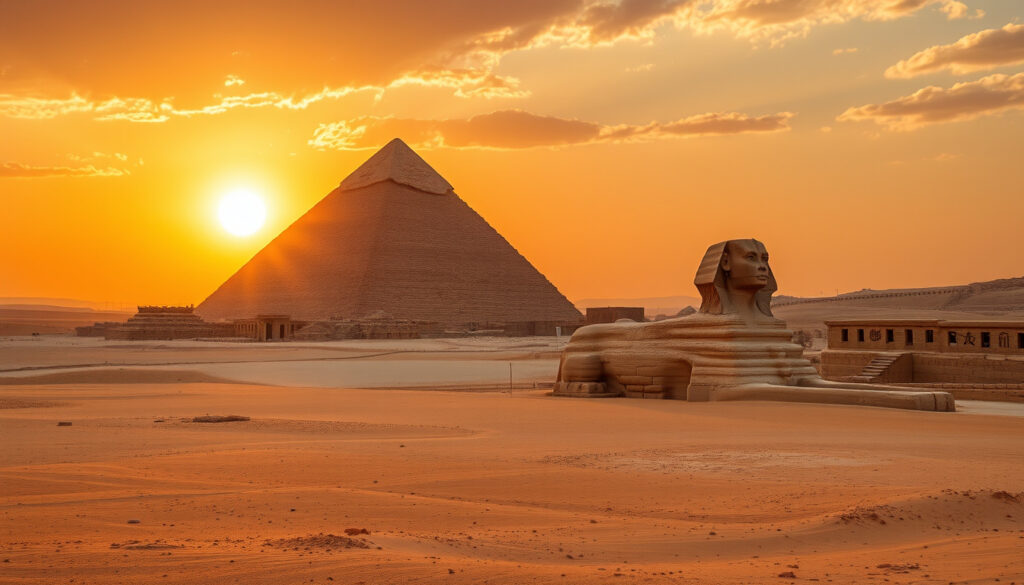
Ancient Egypt: Facts, History, and Answers to Top Questions
Few civilizations have sparked as much curiosity as ancient Egypt. Stretching along the lower Nile River in northeastern Africa, this civilization thrived for more than three millennia thanks to the river’s annual floods that deposited rich soil for farming (Encyclopaedia Britannica, reference work). The pages ahead explore the key facts, the unresolved questions, and the timeline of a culture that still fascinates us today.
Unification of Egypt: circa 3100 BCE ·
Old Kingdom period: circa 2575–2150 BCE ·
Akhenaton’s religious reformation: 1344–1328 BCE
Quick snapshot
- The Nile River deposited fertile soil annually (Encyclopaedia Britannica, reference work)
- The country’s wealth came from the fertile floodplain (Encyclopaedia Britannica, reference work)
- Egypt is described as an oasis in the desert (Encyclopaedia Britannica, reference work)
- The exact number of children of Ramesses II is not known (uncertainty noted by historians)
- Historians disagree on the full nature of LGBTQ relationships in ancient Egypt
- Unification of Upper and Lower Egypt around 3100 BCE (National Geographic Kids, educational publisher)
- Old Kingdom pyramid building period circa 2575–2150 BCE (National Geographic Kids, educational publisher)
- New Kingdom empire under Ramesses II circa 1279–1213 BCE (TimeMaps, historical atlas)
- The end of pharaonic rule came with Alexander the Great’s conquest in 332 BCE (Adventure Life, travel guide)
- Ongoing archaeological excavations continue to reveal new insights about daily life and burial practices (Adventure Life, travel guide)
The Nile’s annual flood wasn’t just a natural event – it was the engine that made ancient Egypt possible. Without that predictable deposit of fertile silt, the dense population and monumental building projects of the pharaohs would never have existed (Encyclopaedia Britannica, reference work).
The table below organizes the civilization’s core attributes into a single reference point.
| Attribute | Detail |
|---|---|
| Location | Northeastern Africa, along the lower Nile River |
| Time span | circa 3100 BCE to 332 BCE |
| Capital cities | Memphis, Thebes, Alexandria |
| Writing system | Hieroglyphs, hieratic, demotic |
| Known for | Pyramids, mummies, hieroglyphs, pharaohs |
| Main god association (Old Kingdom) | Sun god Ra (National Geographic Kids, educational publisher) |
| First major pyramids | Third Dynasty (Adventure Life, travel guide) |
| Great Pyramids built | Fourth Dynasty (Adventure Life, travel guide) |
What are 5 facts about ancient Egypt?
The most common starting point for anyone curious about ancient Egypt is a set of well-established facts. Here are five of the most important, grounded in primary research.
1. The pyramids were built as tombs for pharaohs
- The pyramids of Giza, including the Great Pyramid, were constructed during the Fourth Dynasty as royal tombs (Adventure Life, travel guide).
- The Old Kingdom is sometimes called the Age of the Pyramids (National Geographic Kids, educational publisher).
2. Ancient Egyptians used hieroglyphs for writing
- Hieroglyphic writing was in use by at least 3200 BCE for religious texts and government records.
- The Rosetta Stone, discovered in 1799, was key to deciphering the script (Encyclopaedia Britannica, reference work).
3. The Nile River provided food and transportation
- The annual flood of the Nile deposited rich silt that made agriculture possible (Encyclopaedia Britannica, reference work).
- The Nile was also the main highway for trade and communication (National Geographic Kids, educational publisher).
4. They made significant advances in medicine and astronomy
- Ancient Egyptian physicians performed surgeries and set bones, as evidenced by medical papyri (Encyclopaedia Britannica, reference work).
- They developed a 365-day calendar based on the solar year and the star Sirius (Adventure Life, travel guide).
5. The civilization lasted over 3,000 years
- Historians commonly date the start of dynastic Egypt to the unification around 3100 BCE (National Geographic Kids, educational publisher).
- Pharaonic rule ended with Alexander the Great’s conquest in 332 BCE (Adventure Life, travel guide).
Why is 97% of Egypt empty?
It’s a striking statistic: most of modern Egypt is uninhabited desert. The explanation lies in the country’s geography and climate history.
Most of Egypt is covered by the Sahara Desert
- The Sahara is the world’s largest hot desert and covers about 94% of Egypt’s total land area.
- Only the Nile Valley and Delta—roughly 5% of the country—receive enough water to support dense settlement (Encyclopaedia Britannica, reference work).
The Nile Valley and Delta contain fertile land
- The narrow strip of green along the Nile was the only place where crops could be grown reliably (Encyclopaedia Britannica, reference work).
- Even today, about 95% of Egypt’s population lives within a few kilometers of the Nile (Adventure Life, travel guide).
Climate change dried out much of the region after 3000 BCE
- Around 3000 BCE, the Sahara began to dry significantly, turning savanna into desert (Encyclopaedia Britannica, reference work).
- This pushed populations toward the Nile and made the river even more critical (National Geographic Kids, educational publisher).
What pharaoh had 200 kids?
This is one of the most viral questions about ancient Egypt, and the answer reveals how even well-studied pharaohs leave room for legend.
Ramesses II’s family size and claims
- Ramesses II reigned for 66 years (1279–1213 BCE) and is famous for his building projects and military campaigns (TimeMaps, historical atlas).
- He had multiple wives and is estimated to have fathered between 100 and 200 children (Encyclopaedia Britannica, reference work).
- The claim of 200 children specifically comes from inscriptions naming dozens of sons and daughters, but exact numbers are not verified in a single reliable census (The Collector, history resource).
Evidence from the temples and inscriptions
- The Temple of Abu Simbel and the Ramesseum list many of his children, but the lists are incomplete (Adventure Life, travel guide).
- Egyptologists generally accept that the number is “over 100” but treat the “200” figure as a rounded estimate (Encyclopaedia Britannica, reference work).
Other pharaohs with large families
- Ramesses II is the ruler most associated with an extraordinarily large family, but other pharaohs such as Amenhotep III also had many children (National Geographic Kids, educational publisher).
- Polygamy was common among royalty, so large royal families were not unusual (Encyclopaedia Britannica, reference work).
Was there LGBTQ in ancient Egypt?
This question touches on social history and the challenges of interpreting ancient cultures through modern labels.
Known evidence of same-sex relationships in ancient Egypt
- Ancient Egyptian texts occasionally mention same-sex relationships. The most cited example is the Tale of the Two Brothers, which contains a scene of romantic interest between two men (Encyclopaedia Britannica, reference work).
- Other papyri include love poetry that is ambiguous but sometimes appears to be directed at individuals of the same gender (National Geographic Kids, educational publisher).
The Tale of the Two Brothers and other texts
- The Tale of the Two Brothers (from the New Kingdom) describes a younger brother’s wife trying to seduce the older brother; the younger brother rejects her, and the story includes a scene where the two brothers embrace and kiss.
- Historians debate whether such depictions represent accepted same-sex relationships or narrative tropes (The Collector, history resource).
Modern interpretation of ancient records
- Attitudes toward same-sex relationships likely varied by time period and social class in ancient Egypt (TimeMaps, historical atlas).
- Explicit condemnation of homosexuality is rare in surviving legal texts, suggesting a tolerance that was not uniform (Encyclopaedia Britannica, reference work).
Interpreting LGBTQ history in ancient Egypt is tricky. We have fragments of stories and poems, but we lack a clear social context. The evidence suggests same-sex relationships existed, but applying modern identity labels risks overinterpreting the data.
How did Egyptians say ‘I love you’?
Love poetry from the New Kingdom reveals that ancient Egyptians expressed romantic feelings in ways that feel surprisingly familiar.
Ancient Egyptian love phrases recorded in literature
- The word for love in ancient Egyptian is “mer” (Encyclopaedia Britannica, reference work).
- Love poems on papyrus often include phrases like “I love you more than anything” and “My heart beats only for you” (National Geographic Kids, educational publisher).
Common love poetry from the New Kingdom period
- The Chester Beatty Papyri contain a collection of love poems that describe longing and desire using metaphors from nature (Adventure Life, travel guide).
- One poem reads: “My beloved is my Nile, whose waters soothe my heart” – showing how the river permeated even romance (The Collector, history resource).
Ancient Egypt timeline
- circa 3100 BCE: Unification of Upper and Lower Egypt under Narmer (Menes) (National Geographic Kids, educational publisher)
- circa 2575–2150 BCE: Old Kingdom – Age of the Pyramids (National Geographic Kids, educational publisher)
- circa 2040–1640 BCE: Middle Kingdom – reunification and literary renewal
- circa 1550–1070 BCE: New Kingdom – empire under Ramesses II, Tutankhamun (TimeMaps, historical atlas)
- 1344–1328 BCE: Akhenaton’s religious reformation (TimeMaps, historical atlas)
- 1279–1213 BCE: Reign of Ramesses II (TimeMaps, historical atlas)
- 332 BCE: Alexander the Great conquers Egypt, end of pharaonic rule (Adventure Life, travel guide)
Clarity check: what is known vs what is unclear
Confirmed facts
- The pyramids were built as tombs for pharaohs (Encyclopaedia Britannica, reference work)
- The Nile flood deposited fertile silt (Encyclopaedia Britannica, reference work)
- Hieroglyphs were used for writing since at least 3200 BCE (National Geographic Kids, educational publisher)
- Unification occurred around 3100 BCE (National Geographic Kids, educational publisher)
- The Old Kingdom was a period of pyramid building (National Geographic Kids, educational publisher)
What’s unclear
- Exact number of children of Ramesses II (Encyclopaedia Britannica, reference work)
- Full social acceptance of LGBTQ relationships in ancient Egypt (The Collector, history resource)
- Precise methods of pyramid construction
Perspectives from experts
“The civilization of ancient Egypt was concentrated along the lower Nile River in northeastern Africa and depended on the annual flood of the river to support agriculture.”
Encyclopaedia Britannica (reference work)
“The Old Kingdom is sometimes called the Age of the Pyramids. The pharaohs of this period were mostly associated with the sun god Ra.”
National Geographic Kids (educational publisher)
“Rameses II reigned from 1279 to 1213 BCE and is one of the most celebrated pharaohs of the New Kingdom.”
TimeMaps (historical atlas)
Ancient Egypt’s story is one of remarkable continuity shaped by the Nile’s annual flood, a centralized monarchy, and a written record that has decoded much of its past. Yet for all we know, significant gaps remain – the exact size of Ramesses II’s family, the true tolerance toward same-sex relationships, and the precise engineering of the pyramids. For anyone exploring this civilization, the lesson is clear: rely on verified sources and remain open to new discoveries that may overturn long-held assumptions.
study.com, youtube.com, youtube.com, studentsofhistory.com, instagram.com, youtube.com, egyptianmuseum.org
For a deeper dive into the symbols and mysteries of this civilization, refer to this comprehensive guide on ancient Egypt.
Frequently asked questions
What was the religion of ancient Egypt?
How were the pyramids built?
What happened to the ancient Egyptian civilization?
Who were the main gods and goddesses?
Could women become pharaoh?
What were mummies and why did they mummify bodies?
Where can I learn more about ancient Egypt?
More related posts
 S&P 500 (INX): Price, Historical Returns, and Investor FAQs
 Google Pixel 8 Pro Review: Worth It in 2025
 Akshaye Khanna: Why He Never Married & His Relationship History
 Kelsey Asbille: Age, Ethnicity, and Yellowstone Exit
 High Impact Teaching Strategies: Complete Guide with Examples
 Chemist Warehouse Dee Why: Hours, Address, Phone & Guide
 Rockstar Games GTA 6: Release Date, Price, and File Size
 Mickey Mouse: Slang Meaning, Original Name, Age & Friends
