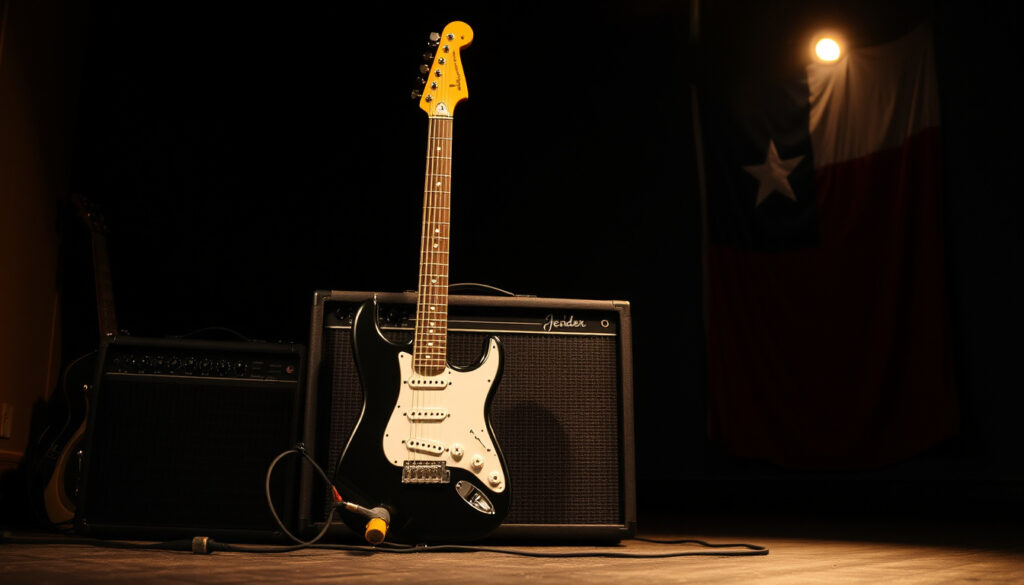
Stevie Ray Vaughan: Biography, Songs, Death, and Legacy
Few guitarists have ever walked into a room and made the air itself seem to vibrate the way Stevie Ray Vaughan did. His sound was huge, his touch was fierce, and his story—rising from the clubs of Austin to global recognition, then vanishing in a foggy Wisconsin field—still feels unfinished. This article separates the man from the myths, looking at the Hendrix comparisons, the Clapton tributes, the real story behind his fingers, and the crash that ended it all.
Born: October 3, 1954 ·
Died: August 27, 1990 (age 35) ·
Primary genre: Blues, Texas blues, electric blues ·
Signature guitar: Fender Stratocaster ‘SRV No. 1’ ·
Notable song: Pride and Joy
Quick snapshot
- Born October 3, 1954 in Dallas, Texas (Texas State Historical Association)
- Frontman of Double Trouble, formed in 1978 (Wikipedia)
- Debut album Texas Flood released in 1983 (Official Stevie Ray Vaughan Site)
- Jimi Hendrix never publicly commented on Vaughan — his personal opinion remains unknown
- Exact crash cause officially ruled pilot error, but some speculation persists
- Whether finger discoloration was solely from smoking or had other contributing factors
- 1954: born in Dallas (Texas State Historical Association)
- 1983: Texas Flood released, national breakthrough (Texas State Historical Association)
- 1990-08-27: killed in helicopter crash (Texas State Historical Association)
- Posthumous releases and box sets continue (e.g. Solos, Sessions & Encores)
- Rock and Roll Hall of Fame induction in 2015
- Ongoing documentary interest and legacy preservation
Eight facts about Stevie Ray Vaughan, one pattern: a life compressed into 35 years that reshaped American blues.
| Label | Value |
|---|---|
| Full name | Stephen Ray Vaughan |
| Born | October 3, 1954, Dallas, Texas, U.S. (Texas State Historical Association) |
| Died | August 27, 1990, East Troy, Wisconsin, U.S. (Texas State Historical Association) |
| Genres | Blues, Texas blues, electric blues, rock |
| Instruments | Guitar, vocals |
| Years active | 1969–1990 (Official Stevie Ray Vaughan Site) |
| Labels | Epic, Legacy |
| Associated acts | Stevie Ray Vaughan and Double Trouble, David Bowie |
Did Jimi Hendrix Like Stevie Ray Vaughan?
What did Jimi Hendrix say about Stevie Ray Vaughan?
- Hendrix died in 1970, before Vaughan’s career took off — there is no record of Hendrix ever hearing or commenting on Vaughan (Wikipedia)
- Vaughan openly idolized Hendrix and covered his songs regularly in concert
The implication: the question itself rests on a timeline gap. Hendrix was gone thirteen years before Texas Flood hit stores.
How did Hendrix influence Stevie Ray Vaughan’s playing?
- Vaughan drew heavily from Hendrix’s tone, vibrato, and showmanship (GRAMMY Museum Mississippi)
- He also studied Albert King, Buddy Guy, Albert Collins, Lonnie Mack, Kenny Burrell, and Wes Montgomery (GRAMMY Museum Mississippi)
The Hendrix comparison tells you more about the listener than the player. Vaughan channeled Hendrix’s fire but built his vocabulary from Texas blues and jazz — the result was a dialect all his own.
Is Stevie Ray Vaughan a Jimi Hendrix ripoff?
- Critics broadly dismiss the “rip-off” label, noting Vaughan’s originality within the blues tradition (Wikipedia)
- He was described as “a leading light in American blues” who “bridged the gap between blues and rock” unlike any artist since the late 1960s (Official Stevie Ray Vaughan Site)
The pattern: Vaughan absorbed Hendrix the way Hendrix absorbed Buddy Guy — as a starting point, not a destination.
What Did Eric Clapton Say About Stevie Ray Vaughan?
Eric Clapton’s tribute to Stevie Ray Vaughan
- Clapton called Vaughan a player of such caliber that “I don’t think anyone has ever been that good” — a remark widely cited in tribute coverage
- Clapton spoke of his admiration and grief after Vaughan’s death, calling the loss “a tragedy for music”
When a guitarist who had shared stages with Hendrix and B.B. King says no one was ever that good, it puts Vaughan’s ability into perspective — not as competition, but as a separate category.
Did Eric Clapton and Stevie Ray Vaughan perform together?
- They played together at the 1989 “Guitar Legends” event in Seville, Spain
- Vaughan also joined Clapton on stage during various other appearances
What this means: the two shared a mutual respect that went beyond public statements — they traded solos on the same stage.
What Was Stevie Ray Vaughan’s Number One Song?
Stevie Ray Vaughan’s biggest hits
- His only number one on any chart was “Pride and Joy,” which topped the Billboard Blues chart
- He never reached number one on the pop Hot 100; his highest pop-charting single was “Pride and Joy” at number 20 on the Mainstream Rock chart
Did Stevie Ray Vaughan have a pop number one?
- No. Vaughan’s commercial success was concentrated in blues and rock formats, not mainstream pop
- Other notable songs include “Texas Flood,” “Cold Shot,” and “Crossfire”
The catch: Vaughan never needed a pop chart to define his reach — his albums sold millions without radio hits.
When Did Stevie Ray Vaughan Come Out?
What was Stevie Ray Vaughan’s debut album?
- His debut album Texas Flood was released in 1983 (Official Stevie Ray Vaughan Site)
- The album was recorded in just two days and became a commercial and critical success
Early career milestones
- Vaughan began playing guitar at age 7, inspired by his older brother Jimmie (Official Stevie Ray Vaughan Site)
- By 12, he was playing in garage bands; at 17, he dropped out of high school to pursue music full-time (Official Stevie Ray Vaughan Site)
- He moved to Austin in 1972 and formed Double Trouble in 1978 (Texas State Historical Association)
- His breakthrough performance at the Montreux Jazz Festival in 1982 caught the attention of David Bowie and Epic Records
The implication: Vaughan’s “overnight success” in 1983 was actually 15 years of club gigs, garage bands, and relentless practice.
Why Did Stevie Ray Vaughan’s Fingers Turn Black?
Stevie Ray Vaughan’s finger injury or discoloration
- The black discoloration on Vaughan’s fingers was caused by nicotine and tar stains from heavy smoking — not a medical condition or playing injury
- He also developed thick calluses from constant playing, which darkened over time
How did he treat his fingers?
- After completing rehab and quitting smoking, the discoloration noticeably faded
- No medical treatment was required — the staining was cosmetic and resolved with lifestyle changes
What this means: the “black fingers” myth has a mundane explanation. It was never an injury, never a sign of drug use — just nicotine, time, and a lot of blues.
Who Else Died in the Crash with Stevie Ray Vaughan?
Details of the 1990 helicopter crash
- The helicopter crashed into a hill near East Troy, Wisconsin on August 27, 1990, after a concert at Alpine Valley (Texas State Historical Association)
- All four on board died: Vaughan, pilot Jeff Brown, tour manager Bobby Brooks, and bodyguard Nigel Browne
What caused the crash?
- The official determination was pilot error compounded by poor visibility in fog
- The helicopter, a Bell 206B, departed in darkness and low cloud cover and struck the ski hill
The trade-off: Vaughan had just played one of the best shows of his life. The decision to fly out that night, on that weather, turned a triumph into a tragedy.
Timeline: Stevie Ray Vaughan’s Life and Career
- 1954 — Born in Dallas, Texas (Texas State Historical Association)
- 1978 — Forms band Double Trouble (Wikipedia)
- 1982 — Performance at Montreux Jazz Festival attracts label attention
- 1983 — Debut album Texas Flood released (Official Stevie Ray Vaughan Site)
- 1985 — Second album Couldn’t Stand the Weather; enters rehab
- 1989 — Album In Step released; sober period
- 1990-08-27 — Killed in helicopter crash after concert at Alpine Valley (Texas State Historical Association)
The pattern: Vaughan’s arc was compressed but complete — from club musician to international star, with a legacy that grew louder after silence.
What’s Confirmed — and What’s Still Unclear
Confirmed facts
- Vaughan’s birth and death dates as recorded by the Texas State Historical Association
- He was a guitarist and frontman for Double Trouble
- He died in a helicopter crash with three others: Jeff Brown, Bobby Brooks, and Nigel Browne
- His only number one single is “Pride and Joy” on the Billboard Blues chart
- He won six Grammy Awards and was inducted into the Rock and Roll Hall of Fame in 2015
What remains unclear
- Jimi Hendrix’s personal opinion of Vaughan — no public statement exists
- Exact cause of the crash beyond official ruling of pilot error (some speculation about mechanical factors persists)
- Whether Vaughan’s finger discoloration resulted solely from smoking or also from other factors
What this means: the public record on Vaughan is solid where it matters most — his music, his battle with addiction, and the facts of his death — while the myths around him remain peripheral.
Quotes from Those Who Knew Him
“I don’t think anyone has ever been that good.”
— Eric Clapton, paying tribute to Vaughan’s skill after his death
“He was one of the greatest guitarists I ever heard.”
— B.B. King, on Vaughan’s ability and legacy
“He was a leading light in American blues from 1983 to 1990, bridging the gap between blues and rock like no other artist since the late 1960s.”
— The Official Stevie Ray Vaughan Site
For anyone who missed seeing him live, the recorded work — especially the live albums — remains the closest thing to standing in a room while the air vibrated.
Related reading: **Chris Rea Songs: Biggest Hits, Number Ones, and Best Songs**
Frequently asked questions
How tall was Stevie Ray Vaughan?
He was approximately 5 feet 8 inches (173 cm) tall.
What guitar did Stevie Ray Vaughan play?
His primary guitar was a 1963 Fender Stratocaster known as “SRV No. 1,” which he used for most of his recordings and performances.
Did Stevie Ray Vaughan win a Grammy?
Yes. He won six Grammy Awards during his career, including Best Blues Album and Best Rock Instrumental Performance.
What is Stevie Ray Vaughan’s legacy?
He is widely credited with revitalizing blues music in the 1980s and inspiring a generation of guitarists across rock, blues, and beyond. He was inducted into the Rock and Roll Hall of Fame in 2015.
How many albums did Stevie Ray Vaughan release?
He released four studio albums with Double Trouble: Texas Flood (1983), Couldn’t Stand the Weather (1984), Soul to Soul (1985), and In Step (1989), plus numerous live and posthumous releases.
Was Stevie Ray Vaughan married?
Yes. He married Lenora “Lenny” Vaughan in 1981, though they were separated at the time of his death.
What was Stevie Ray Vaughan’s first album?
His first album was Texas Flood, released in 1983 by Epic Records.
More related posts
 Laurence Fishburne: Biography, Career, and Family
 Michael Burry MD: Medical Degree, Net Worth, Diagnosis
 Vending Machine Business: Costs, Profitability & How to Start
 Damian Hardung: Biography, Medical School & Facts
 English to Gujarati – Free Tools, Apps and Guides
 Benny Hill: Biography, Death, Grave Robbery, and More
 Jasprit Bumrah: Injury, Net Worth, Wife, Stats & More
 Big W Kingston – Hours, Location and Contacts Guide
