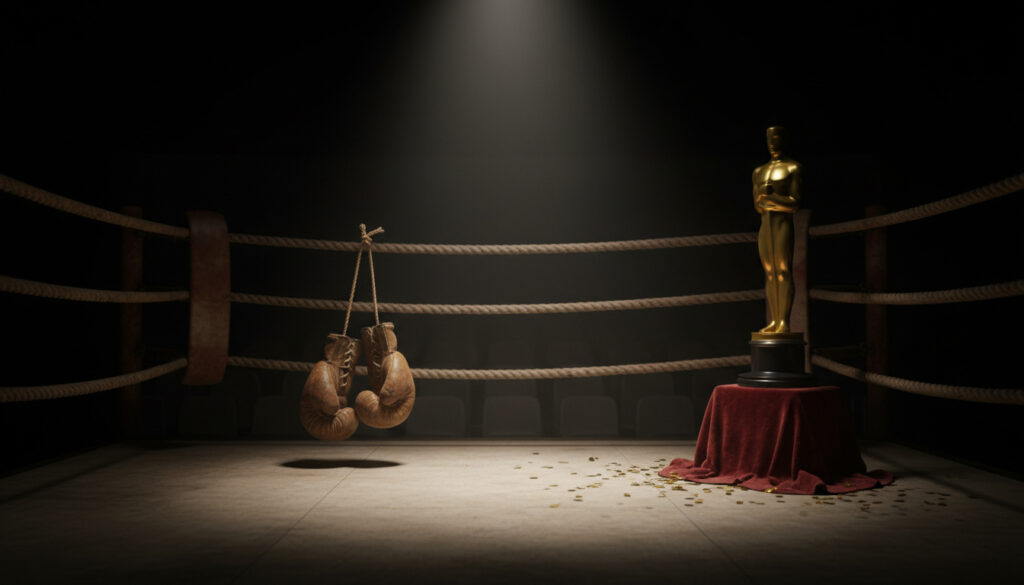
Million Dollar Baby – Cast, Oscars, Ending Explained
Million Dollar Baby emerged in 2004 as a devastating portrait of sacrifice and mortality within the brutal world of professional boxing. Directed by Clint Eastwood, who also stars as the grizzled trainer Frankie Dunn, the film adapts short stories by boxing cutman F.X. Toole from his 2000 collection Rope Burns: Stories from the Corner. It defied genre conventions to become a meditation on loyalty, estrangement, and the ethics of mercy killing.
Hilary Swank delivers a transformative performance as Maggie Fitzgerald, a 31-year-old waitress from the Missouri Ozarks who refuses to accept the limitations imposed by her age and gender. Morgan Freeman provides the film’s moral center as Eddie “Scrap-Iron” Dupris, a former boxer who narrates the tragedy from his position as gym caretaker. The production earned widespread critical acclaim and dominated the 77th Academy Awards, securing four Oscars including Best Picture.
The film’s controversial third-act twist sparked intense debate about euthanasia and surrogate family bonds. Eastwood’s direction emphasizes gritty realism through patient pacing and velvety shadows, earning praise from Rotten Tomatoes critics as “deeply heartfelt and moving.”
What Is Million Dollar Baby About?
The narrative follows an aging Los Angeles boxing trainer haunted by his estrangement from his daughter. Frankie Dunn initially refuses to train female fighters, viewing the sport as too dangerous for women. Maggie Fitzgerald, possessing raw determination but lacking refinement, eventually convinces him to take her on as a project.
- Adapted from F.X. Toole’s short story collection Rope Burns, published in 2000
- Hilary Swank underwent intensive boxing training to portray a convincing welterweight contender
- Clint Eastwood composed the film’s melancholic original score in addition to directing and starring
- The production generated significant controversy for its unflinching depiction of assisted suicide
- Lucia Rijker, a real-life professional boxer and kickboxing champion, portrays the ruthless antagonist
- The Gaelic endearment “Mo Cuishle” translates to “my darling, my blood”
- Anthony Mackie appears early in his career as Shawrelle Berry, a rival gym fighter
| Attribute | Details |
|---|---|
| Director | Clint Eastwood |
| Screenplay | Paul Haggis |
| Source Material | Rope Burns by F.X. Toole |
| Release Year | 2004 |
| Lead Actress | Hilary Swank (Maggie Fitzgerald) |
| Lead Actor | Clint Eastwood (Frankie Dunn) |
| Narrator | Morgan Freeman (Eddie “Scrap-Iron” Dupris) |
| Oscars Won | 4 (Best Picture, Director, Actress, Supporting Actor) |
| Total Nominations | 7 |
| Primary Setting | Los Angeles, California |
Million Dollar Baby Cast and Crew
Lead Performances
Eastwood inhabits Frankie Dunn as a man consumed by regret, his weathered features mirroring the character’s spiritual fatigue. His performance earned an Academy Award nomination for Best Actor, though the statue eluded him. Swank transformed her physique to portray Maggie, gaining nearly 20 pounds of muscle through a rigorous four-month training regimen. Her portrayal captured both the physical ferocity and emotional vulnerability of a woman fighting against geographic and socioeconomic constraints.
Freeman’s Eddie Dupris serves as the film’s conscience and narrative anchor. Cast details from Fandango confirm Freeman’s role as both supporting character and narrator, his distinctive cadence guiding viewers through the moral complexities of the final act.
Lucia Rijker, who portrays the ruthless champion Billie “The Blue Bear,” brought genuine fighting credentials to the production. A retired professional boxer and kickboxer, Rijker was inducted into the Women’s Boxing Hall of Fame in 2020, lending visceral authenticity to the film’s climactic bout.
Supporting Ensemble
The gym ecosystem features Anthony Mackie as Shawrelle Berry, a talented but arrogant fighter who initially mocks Maggie’s ambitions. Jay Baruchel appears as Danger Barch, an enthusiastic novice with more heart than skill. TV Guide’s cast listing also includes Mike Colter as Big Willie Little, Margo Martindale as Maggie’s indifferent mother Earline, and Riki Lindhome as her sister Mardell.
Behind the Camera
Paul Haggis adapted Toole’s stories into a screenplay that balanced sports-film expectations with literary tragedy. Tom Stern’s cinematography employed high-contrast lighting that recalled classic film noir, emphasizing the stark physical toll of boxing. Eastwood’s production team constructed the Hit Pit Gym on a soundstage, creating a lived-in environment cluttered with decades of boxing memorabilia.
Million Dollar Baby Oscars and Awards
Academy Award Dominance
The 77th Academy Awards ceremony saw Million Dollar Baby capture four of the seven categories in which it competed. Britannica’s film entry documents the clean sweep in major categories: Best Picture, Best Director (Eastwood), Best Actress (Swank), and Best Supporting Actor (Freeman). This marked Eastwood’s second Best Director win following Unforgiven (1992).
The film also earned nominations for Best Actor (Eastwood), Best Film Editing, and Best Adapted Screenplay. Its victories represented a rare instance of a late-year release (December 15, 2004) gaining sufficient momentum to overcome earlier contenders during the awards season.
Critical Consensus
Retrospective assessments have cemented the film’s reputation as one of Eastwood’s most assured directorial efforts. Critics highlighted the performances by Swank and Freeman as transcending sports-drama clichés, while noting the screenplay’s refusal to provide easy emotional catharsis. The Rotten Tomatoes Critics Consensus praises the film as “a masterpiece” that “ranks among Eastwood’s finest works.”
Is Million Dollar Baby Based on a True Story?
The narrative derives entirely from fiction. Fandom’s film database clarifies that while F.X. Toole (the pen name of Jerry Boyd) drew upon decades of experience as a Los Angeles boxing cutman, the specific characters and plot remain invented. Boyd published the Rope Burns collection in 2000, three years after retiring from the fight game, having written the stories across the preceding decades.
Boyd worked as a cutman from the 1970s through the 1990s, tending to fighters’ wounds between rounds. His insider knowledge informed the authentic gym culture depicted in the film, though Maggie Fitzgerald, Frankie Dunn, and Eddie Dupris exist solely within the realm of fiction.
The screenplay by Paul Haggis synthesized elements from multiple stories within the collection, creating a cohesive narrative arc that maintained Toole’s unvarnished perspective on the boxing underworld. No real-world boxer suffered the specific injuries or circumstances depicted in the film’s tragic conclusion.
Million Dollar Baby Ending Explained
The Championship Tragedy
Maggie’s ascent culminates in a welterweight title fight against Billie “The Blue Bear” in Las Vegas. During the bout, Billie delivers an illegal punch after the bell rings—a “sucker punch” that sends Maggie crashing into her corner stool. The impact severs her spinal cord, leaving her quadriplegic with a C1-C2 injury.
The Euthanasia Request
Confined to a hospital bed and dependent on a ventilator, Maggie loses a leg to gangrene. After attempting suicide by biting her tongue to bleed out, she begs Frankie to end her suffering. The film presents this request through the prism of their father-daughter bond, complicating straightforward moral judgments about assisted suicide.
The film’s opening and closing narration reveals that Eddie Dupris’s voiceover constitutes a letter addressed to Frankie’s estranged daughter. This framing device explains that Frankie disappeared after granting Maggie’s request, never returning to the gym or his previous life.
The Final Act
Frankie ultimately administers a lethal dose of adrenaline to Maggie. The Letterboxd community analysis notes that the film reveals the true meaning of “Mo Cuishle”—the Gaelic phrase Frankie had inscribed on Maggie’s boxing robe—as “my darling, my blood,” signifying the depth of their surrogate familial connection.
How Did Million Dollar Baby Develop?
- : Jerry Boyd works as a cutman while writing short stories under the pen name F.X. Toole
- : Rope Burns: Stories from the Corner publishes to critical acclaim
- : Clint Eastwood acquires rights and begins production with Lakeshore Entertainment
- : Limited theatrical release begins, generating immediate awards buzz
- : Film wins four Academy Awards at the 77th ceremony
What Are the Verified Facts About Million Dollar Baby?
Established Information
- Fictional narrative based on F.X. Toole’s short stories
- Won four Academy Awards (Picture, Director, Actress, Supporting Actor)
- Euthanasia theme intentionally explored as central moral conflict
- “Mo Cuishle” translates from Gaelic as “my darling, my blood”
- Released in December 2004
- Paul Haggis wrote the adapted screenplay
Information Remaining Unclear
- Specific production budget figures
- Exact domestic and international box office totals
- Official runtime specifications
- Current streaming availability for 2024-2025 (subject to platform licensing changes)
- Specific viewership data from streaming releases
What Cultural Impact Did Million Dollar Baby Leave?
The film redefined the boxing genre by rejecting triumphant underdog tropes in favor of tragic realism. Its influence appears in subsequent sports dramas that similarly prioritize character psychology over athletic spectacle. The movie also intensified public discourse regarding euthanasia legislation, particularly concerning patients with catastrophic spinal injuries.
Eastwood’s spare directorial approach—relying on silence, shadow, and contained performances—influenced a generation of American independent filmmakers. The movie stands alongside Mamma Mia 2 – Cast, Plot, Songs and Facts as a 2000s studio release that demonstrated the viability of dramas targeting adult demographics during the superhero era’s rise.
What Do Critics and Sources Say?
Clint Eastwood’s assured direction—combined with knockout performances from Hilary Swank and Morgan Freeman—help Million Dollar Baby transcends clichés and rises to become a masterpiece.
— Rotten Tomatoes Critics Consensus
Academic film studies have analyzed the work as an exploration of surrogate family structures within hyper-masculine environments. The gym serves as a sanctuary for broken men, with Maggie’s intrusion forcing Frankie to confront his failures as a biological father.
Why Does Million Dollar Baby Still Matter?
Two decades after its release, the film endures as a benchmark for performances and morally complex storytelling. Its refusal to offer easy redemption or cathartic victory distinguishes it from conventional sports cinema. Viewers seeking similar explorations of performance and family dynamics might also examine Mamma Mia 2 cast and plot, though the tonal approaches differ significantly.
Frequently Asked Questions
Where can I watch Million Dollar Baby?
Specific 2024-2025 streaming availability remains subject to regional licensing agreements. Viewers should consult major platforms such as those linked through Fandango or TV Guide for current rental and streaming options.
Who was the boxing trainer in Million Dollar Baby?
Clint Eastwood portrays Frankie Dunn, a veteran trainer who initially resists training Maggie Fitzgerald due to his concerns about women boxing and his own fear of emotional connection.
What does Mo Cuishle mean?
The phrase derives from Irish Gaelic meaning “my darling, my blood.” Frankie inscribes it on Maggie’s boxing robe without initially revealing the translation to her.
Who played Billie the Blue Bear?
Lucia Rijker, a retired professional boxer and kickboxing world champion, portrayed the dirty fighter who causes Maggie’s career-ending injury.
Did Million Dollar Baby win Best Picture?
Yes. The film won the Academy Award for Best Picture at the 77th Academy Awards in February 2005, along with three additional Oscars.
Who wrote the screenplay?
Paul Haggis wrote the adapted screenplay based on short stories by F.X. Toole from the book Rope Burns: Stories from the Corner.
What book is Million Dollar Baby based on?
The film adapts material from Rope Burns: Stories from the Corner, a 2000 collection of short stories by Jerry Boyd writing under the pseudonym F.X. Toole.
More related posts
 John Schneider: Latest News, Marriages, Political Views
 Best Travel Credit Cards No Fees: Zero Annual & Foreign Fees
 Peter Thomas Roth: Founder, Net Worth, and Product Reviews
 Randy Orton: Biography, Net Worth, Health, and Career Updates
 Sun Tzu: Facts, Quotes, The Art of War & Historical Accuracy
 Mariska Hargitay: Tragic Story, Ethnicity, Children & Illness
 Origin Energy Com Au: Contacts, Login, Comparisons Guide
 Kevin Federline: What Happened to Britney’s Ex in 2025
